




1998 Johnson 115 Fast Strike Vapor Separator Tank (VST) bypass?

Longarch

Cadet
Joined
Jul 10, 2026
Messages
6
Can this system be successfully done by adding a 4 - 7PSI electric fuel pump, heat protective hose sleeve to fuel lines, and a Wix 33041 fuel filter with restricted bypass returning to tank? If yes, is anyone able to help me identify the purpose of all the hoses attached to the VST? I have no need for the choke/primer solenoid. The VST has been nothing short of a headache and I ran the outboard for a short time directly by connecting the inlet fuel line to the two lines feeding the four carburetors. I believe all but maybe one may be plugged and not cause any issues.

 

saltchuckmatt

Captain
Joined
Jul 19, 2019
Messages
3,284
Can this system be successfully done by adding a 4 - 7PSI electric fuel pump, heat protective hose sleeve to fuel lines, and a Wix 33041 fuel filter with restricted bypass returning to tank? If yes, is anyone able to help me identify the purpose of all the hoses attached to the VST? I have no need for the choke/primer solenoid. The VST has been nothing short of a headache and I ran the outboard for a short time directly by connecting the inlet fuel line to the two lines feeding the four carburetors. I believe all but maybe one may be plugged and not cause any issues.
You talking vro?
 

Chris1956

Supreme Mariner
Joined
Mar 25, 2004
Messages
28,939
Gee, the VST is real simple. It fills with fuel and gravity feeds the OMS pump. Have you replaced the VST cover gasket and float and inlet needle? Is it cracked? Have you rebuilt the vapor pump?
 

Chris1956

Supreme Mariner
Joined
Mar 25, 2004
Messages
28,939
An electric fuel pump would need to shut off if the motor stalls, for safety. Normally this done with a relay on the voltage regulator, plus some other wiring.

For example, let's say a fuel line to the carbs starts to leak. If the leak is bad enough the motor will stall, and the electric fuel pump will continue to pump at full blast. If the OB cowl gets raw fuel in it, and you crank the motor to restart it, bad things can happen.

Mechanical fuel pumps do not have this issue.
 

Longarch

Cadet
Joined
Jul 10, 2026
Messages
6
saltchuckmatt - It is a standard 115 outboard. Not a VRO.

Chris1956 - Yes, the VST is simple and causing me issues. I did replace the cover gasket and filter, as well as ensuring all the hoses feeding it had a good seal. I agree with the electric fuel pump leading to problems. Unfortunately, the boat was purchased with the manual fuel pump being replaced with an electric.

flyingscott - Does it really? Can it not be replaced?

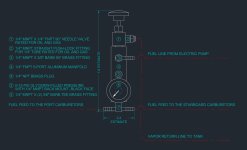
I was considering doing what I've drawn in the attached image. It should allow capture of any vapor bubbles and return them to the tank as well as ensure no bubbles reach the carbs and the whole circuit with exception of the lines from the VST to the carbs being constantly circulated thus negating any vapor bubbles. Thoughts?
 

Attachments

  • VST Replacement 2.jpg
    VST Replacement 2.jpg
    154.7 KB · Views: 1

cwella

Seaman
Joined
Jul 10, 2026
Messages
51
Can this system be successfully done by adding a 4 - 7PSI electric fuel pump, heat protective hose sleeve to fuel lines, and a Wix 33041 fuel filter with restricted bypass returning to tank? If yes, is anyone able to help me identify the purpose of all the hoses attached to the VST? I have no need for the choke/primer solenoid. The VST has been nothing short of a headache and I ran the outboard for a short time directly by connecting the inlet fuel line to the two lines feeding the four carburetors. I believe all but maybe one may be plugged and not cause any issues.
Your idea may work, but I’d double-check the VST hose functions before plugging anything. The VST usually helps keep fuel delivery consistent, so making sure the pressure and venting are right is important. If you can share the model/year or a picture of the VST, someone may be able to help identify each hose. Running it directly to the carbs is a good test, just keep an eye out for flooding or fuel starvation.
 

dingbat

Supreme Mariner
Joined
Nov 20, 2001
Messages
17,228
Somethings not right......
A VST on a carburetor engine?
VST are typically used on injected engines IE Ficht

I can find no mention of Evinrude using a VST on any carburetor engine.
 

Longarch

Cadet
Joined
Jul 10, 2026
Messages
6
Your idea may work, but I’d double-check the VST hose functions before plugging anything. The VST usually helps keep fuel delivery consistent, so making sure the pressure and venting are right is important. If you can share the model/year or a picture of the VST, someone may be able to help identify each hose. Running it directly to the carbs is a good test, just keep an eye out for flooding or fuel starvation.
I had originally planned on adding a 1/4" in-line pressure reducer with a 0.50" to 0.625" orifice but decided to go with a locking needle valve that I may adjust the flow, which in turn adjusts the PSI on the carbs. Fingers crossed. I'm going to try this set up. ;)
 

cwella

Seaman
Joined
Jul 10, 2026
Messages
51
That sounds like a good plan. The locking needle valve should give you some flexibility to fine tune the flow instead of being limited to a fixed orifice. Just make small adjustments and see how the carbs respond. Hopefully this setup gets everything running smoothly. Fingers crossed! 👍🙂
 

Longarch

Cadet
Joined
Jul 10, 2026
Messages
6
Somethings not right......
A VST on a carburetor engine?
VST are typically used on injected engines IE Ficht

I can find no mention of Evinrude using a VST on any carburetor engine.
I may be calling it by the wrong name. My outboard is a J115GLECM.
 

Longarch

Cadet
Joined
Jul 10, 2026
Messages
6
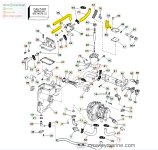
No. It's called a Vapor Separator (VST). These are the hoses I wish to remove and plug the ports.
 

Attachments

  • VST Hoses.jpg
    VST Hoses.jpg
    298.2 KB · Views: 8

saltchuckmatt

Captain
Joined
Jul 19, 2019
Messages
3,284
No. It's called a Vapor Separator (VST). These are the hoses I wish to remove and plug the ports.
Not sure what that picture is. I thought maybe you have a ficht motor....in your breakdown there's clearly a vro2 on the right side. Also shows a small pulse pump and a vst.

Throws me for a loop.
 

racerone

Supreme Mariner
Joined
Dec 28, 2013
Messages
39,754
????---Vapor separator was used on the 60 degree V-6 beginning in 91 and on the V-4 model 60 degree motors beginning in 95 model year.----Very common item !
 

cwella

Seaman
Joined
Jul 10, 2026
Messages
51
Fair point, they weren’t common on older carbureted setups. The difference is that modern fuel formulations, tighter emissions requirements, higher operating temperatures, and different fuel system designs can make vapor issues more noticeable today. Vapor separators aren’t always necessary on every system, but they can help prevent fuel starvation, improve reliability, and reduce vapor lock problems in certain applications. It really depends on the engine, fuel system, and operating conditions.
Gee, Matt, we had 60 years of carb's OBs without vapor separators. Why do we need them now?
 

saltchuckmatt

Captain
Joined
Jul 19, 2019
Messages
3,284
Fair point, they weren’t common on older carbureted setups. The difference is that modern fuel formulations, tighter emissions requirements, higher operating temperatures, and different fuel system designs can make vapor issues more noticeable today. Vapor separators aren’t always necessary on every system, but they can help prevent fuel starvation, improve reliability, and reduce vapor lock problems in certain applications. It really depends on the engine, fuel system, and operating conditions.
And help profit margins for service shops...which btw seems to be a newer industrie standard.
 

Crosbyman

Admiral
Joined
Nov 5, 2006
Messages
6,191
old carbs also have a vent if vapors build up thanks to the need to balance with the atmosphere to let fuel enter the bowl...... natural venting not available in closed fuel systems especially....injection systems
 
Top