




1975 mercury 115, no power to coil.

85gslse

Recruit
Joined
Jul 1, 2019
Messages
2
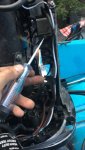
I am pretty new to outboard engines, i am getting power into this box (i believe its called the CDI. the wire coming off to the coil is not putting any power out. is this box possibly bad or could it be something else? i have constant and switched power coming into the box but nothing on the positive going to the coil while either sitting or cranking. IMG-1562.JPG
 

Chris1956

Supreme Mariner
Joined
Mar 25, 2004
Messages
28,566
You should get a spike of power on the green wire, while cranking. It is very likely that a voltmeter will not react fast enough to see it. This ignition is not like an automotive battery/coil ignition which has a constant 8V DC on the coil.


Most Merc coils are good, so the way to test spark is to remove the high tension wire from the distributor cap (it unscrews), hold it near the block and crank her to see if the coil fires.

If she doesn't fire, you can run a test on your wiring and switchbox, using the procedure on the CDI Electronics web site. At this point most of those engine wiring harnesses are bad. Also, the trigger tends to go first.
 

Faztbullet

Supreme Mariner
Joined
Mar 2, 2008
Messages
15,937
Do inline trigger test.....

CAUTIon; DO NOT Use A MAINTENANCE FREE Battery with these TypeS of ignitions As theY TEND To OVERCHARGE and BLOW the Packs. Typically 17 Volts +.
Note: A large portion of the problems with the battery CD units are caused by low battery voltage or bad ground connections or high battery voltage. Low Voltage symptoms are weak erratic firing of cylinders. Misfiring after a few minutes of running can be caused by excessive (Over 15.5 Volts DC) voltage at the pack. - Warning : Check the voltage on the red (or purple) Wire at the CD Unit through the RPM range. At no time should the voltage exceed 15.5 Volts DC.
Warning!! Battery REVERSAL WILL USUALLY DESTROY Battery CDs and TRIGGERS.
1) Check all battery and ground connections.
Check the voltage on the red and white Ignition wires at the CD Unit. If the voltage is less than 9 1/2 volts during cranking there is a problem in the battery s or the Ignition switch Box. These units require at least 9 1/2 volts to fire properly. On a 332-2986 switch Box, check the voltage on the brown terminal (white/black for 332-47960 where the Trigger is hooked up. It requires at least 9V at cranking. DVA check between the white and black wires (black and blue on 332-4796). You should read at least 2 1/2 volts at cranking. Connect a jumper Wire directly from the battery POS (+) terminal to the red and white Ignition wires (the red Wire is not needed for the CDI units). CAUTIon: DO NOT Connect the JUMper Wire To the WHITE Trigger Terminal. Retest: ATTENTIon: in order to kill the engine if it cranks, the jumper Wire has to be disconnected and/or choke the engine. If the engine still fails to crank, recheck voltage as above. If low, replace the battery and retry. If there is still no fire, disconnect points Wire (or Trigger wires) and connect the Battery CD tester (511-9701), according to the instructions in the manual, and align the rotor with a spark plug Wire. Connect a spark gap tester (511-9766) to all spark plug wires and turn the Ignition switch on. If the CD Unit fires to only one spark plug Wire, check points Wire (for breaks or shorts) or Trigger. If ANY other spark plug fires besides the one the rotor is aligned with, the distributor cap and rotor should be replaced. The Battery CD tester will fire the system to approximately 3000 RPM. If the Battery CD tester is not used, see related drawings on the Schematic page (following). If the CD Unit fails to fire with this hookup, it is usually bad. Following the instructions included with the Trigger Tester (511-9710) check the Trigger to see if it is good or bad.
3) Engine cranks and fires as long as starter is engaged:
This problem usually indicates a bad Trigger.
 
Top