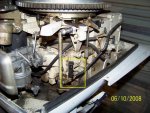
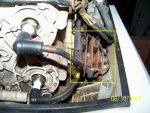
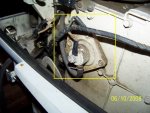
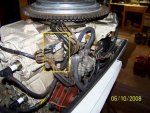
What are these parts?

markh28

Petty Officer 3rd Class
Joined
May 12, 2008
Messages
93
This is a Scott McCulloch, 1959, 40HP motor with electric start. I am not getting any spark, even after changing the plugs, condensers, and points. I am wondering if I dont have something shorted out. Just wondering what these parts are since they all seem to be electrical and possibly the cause of my problem.
 

Attachments

  • Pic1.jpg
    Pic1.jpg
    69.9 KB · Views: 2
  • Pic2.jpg
    Pic2.jpg
    62.5 KB · Views: 1
  • Pic3.jpg
    Pic3.jpg
    55.1 KB · Views: 1
  • Pic4.jpg
    Pic4.jpg
    67.6 KB · Views: 2

tmcalavy

Rear Admiral
Joined
Aug 29, 2001
Messages
4,005
Re: What are these parts?

Does it have a kill switch? If so, check that first. If you haven't monkeyed with the wires shown in any of the photos, it's unlikely they're shorted out unless you see a break in the wire(s) somewhere and obvious contact.
 

steelespike

Supreme Mariner
Joined
Apr 26, 2002
Messages
19,069
Re: What are these parts?

If it is a battery ignition there is a ballast resistor mounted on the power head
it is designed to protect the points if the ignition is left on.Should be checked.
There is also a distributor plate that has a ground lead.Ignition switch is closed for on and open to kill.
Early models have a mageneto generator assembly with 2 ignition coils and a series of generator coils.alternating.Ignition switch is open to run closed to kill ignition.
 

markh28

Petty Officer 3rd Class
Joined
May 12, 2008
Messages
93
Re: What are these parts?

This particular motor has electric start and a generator. I can identify the generator coils when I pull the powerhead.

I dont know if it has a kill switch, although its acting like there is one and its "killed" because I did have spark for a while, but between pulling spark plug wires, pulling off points, readjusting points, changing condensers, now there isnt any spark. I just dont know what to look for in the kill switch. On the newer motors I know its black and yellow wires. On this one the wires are almost all the same color.

This balast resistor has me wondernig...what do they look like? And is it visible in any of the pictures I posted?

Also, in pic4 that black part that I drew the box around has a label on it that says "Disconnect one wire for hand starting" and has what looks like some sort of solenoid near it. What would that be? The two wires that connect to it are very loose, and lead back up into the ignition area under the flywheel.

I dont have the actual manual for this, just the clymer manual for "under 40 HP" and this is a 40. The Scott pages in that manual dont help me much as far as identification of those parts I took pictures of.

 

F_R

Supreme Mariner
Joined
Jul 7, 2006
Messages
28,226
Re: What are these parts?

It doesn't have a "kill" switch per se. The ignition switch feeds voltage from the battery through the ign switch, through the ballast resistor, to the coils. Send me your e-mail address in a PM and I'll see if I can walk you through this.

I believe picture #1 is a safety switch preventing starting at high throttle settings. #2, the finned red thing, is a selenium rectifier for changing AC from the alternator to DC for charging the battery. #3 is a vacuum cut-out switch for preventing run-away, and believe me it WILL run away without it. #4, I'll have to ponder on that one.
 

markh28

Petty Officer 3rd Class
Joined
May 12, 2008
Messages
93
Re: What are these parts?

The part in pic#4 has wires that were connected to each of the points in the ignition, which is why I was thinking that was some knid of kill mechanism. I disconnected both of those wires and now I am getting very weak spark on one cylinder and no spark on the other cylinder. I switched the coils around from one side to the other and went to try it and....now it wont even crank over.

How do I test to see if I fried the starter? Can I test that with a multimeter?

This also may be of note, when I am connecting the leads to the battery, parts in pic#4 do a lot of "snap crackle pop" as I am tightening the battery leads. Even with the switch in the off position.
 
Top