













I apologize in advance for the novel but I want to make sure I provide as best a description of my situation as I can.
So I've been posting in other parts of this forum trying to figure out why my 1996 15ft Seahunt CC is only hitting 4400rpm and 22 mph at WOT with a 2002 Yamaha 50hp Four-Stroke (typical 2-man fishing trip weight). I'll give you a very brief synopsis so you all understand the operating condition of the boat- engine got an overhaul and clean bill of health about 4 months ago. Carbs rebuilt, sparkplugs, fuel lines, fuel tank, all replaced. New Yamaha aluminum prop 10 5/8x12. All cylinder pressures checked out and the engine is completely healthy. So having used process of elimination to deduce that my lack of performance wasn't mechanical in nature, with the helpful advice of these forums, I turned to the hull. I grew up on an island, have been driving boats all my life, done plenty of mechanical work, but I am an absolute novice when it comes to any type of glassing or hull repair, so I think subconsciously I was desperately hoping it wasn't hull related. But it appears to be.
The hull has definitely had some patching here and there by the po, but nothing noticeable below the waterline, although it has awfully applied, uneven, orange-peelish bottom paint which might be obscuring quite a bit.Also, along the bottom of the V of the hull, right where the hull would make contact with the sand whenever I beach the boat, I noticed that there's no bottom paint, no gelcoat, and simply some exposed fiberglass. A strip about 1/2" wide and a foot long. Could water seep through here? And could this be the point of ingress?
When I gave the inside of the hull a closer inspection I noticed about an inch or two of sitting water between the areas of foam. (I will have pictures soon). I was going to take a core sample of the foam, but simply by pressing down on the top of it with my finger I can tell its completely soaked. Who knows how long its been exposed to this water. I haven't cut any holes into the floor yet because the notion of doing so scares the crap out of me. I'm going to be entering completely foreign territory when it comes to the properties of fiberglass, and all the other component knowledge necessary to determine the condition of a hull. Terms that I've seen on these forums like stringers, weep holes, limber holes, etc are gibberish to me at the moment. I'm trying to educate myself via these forums, but I plead with anyone that is kind enough to respond to this post to pretend you're explaining things to a child. I should note that I've checked every square inch of the deck for soft spots and have found none. The transom also seems perfectly fine as the sitting water does not actually reach the transom from what I can tell. Although, I will drill some holes into it this weekend to see if there's moisture in the wood.
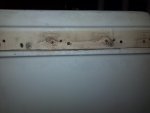
Pictures of the boat, transom, bilge, and sitting water follow. Thank you all so much for any help in advance and thank you iboats for this incredible forum.
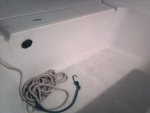
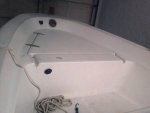
The boat

The bilge
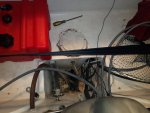
View of the inside of the hull #1 (this porthole is located directly infront of the bilge area)
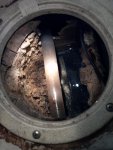
View of the inside of the hull #2 (this is situated right at the driver's feet behind the cc)
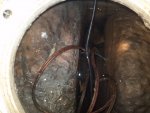
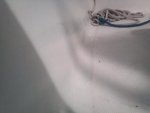
Is this a weep hole for draining this water? If you look closely at the picture labeled inside of hull #1, you'll see at the very bottom a white pvc-type pipe running along the bottom. This hole is where that pipe ends. I noticed the pipe definitely has water in it, but when I stick my finger in there, I can tell is blocked with all sorts of debris. You call also see this hole in the second picture to get a better idea of where its located. In this picture it looks like its a flat hole on the bottom but the hole is actually right on the curve and therefore angled upward.

So I've been posting in other parts of this forum trying to figure out why my 1996 15ft Seahunt CC is only hitting 4400rpm and 22 mph at WOT with a 2002 Yamaha 50hp Four-Stroke (typical 2-man fishing trip weight). I'll give you a very brief synopsis so you all understand the operating condition of the boat- engine got an overhaul and clean bill of health about 4 months ago. Carbs rebuilt, sparkplugs, fuel lines, fuel tank, all replaced. New Yamaha aluminum prop 10 5/8x12. All cylinder pressures checked out and the engine is completely healthy. So having used process of elimination to deduce that my lack of performance wasn't mechanical in nature, with the helpful advice of these forums, I turned to the hull. I grew up on an island, have been driving boats all my life, done plenty of mechanical work, but I am an absolute novice when it comes to any type of glassing or hull repair, so I think subconsciously I was desperately hoping it wasn't hull related. But it appears to be.
The hull has definitely had some patching here and there by the po, but nothing noticeable below the waterline, although it has awfully applied, uneven, orange-peelish bottom paint which might be obscuring quite a bit.Also, along the bottom of the V of the hull, right where the hull would make contact with the sand whenever I beach the boat, I noticed that there's no bottom paint, no gelcoat, and simply some exposed fiberglass. A strip about 1/2" wide and a foot long. Could water seep through here? And could this be the point of ingress?
When I gave the inside of the hull a closer inspection I noticed about an inch or two of sitting water between the areas of foam. (I will have pictures soon). I was going to take a core sample of the foam, but simply by pressing down on the top of it with my finger I can tell its completely soaked. Who knows how long its been exposed to this water. I haven't cut any holes into the floor yet because the notion of doing so scares the crap out of me. I'm going to be entering completely foreign territory when it comes to the properties of fiberglass, and all the other component knowledge necessary to determine the condition of a hull. Terms that I've seen on these forums like stringers, weep holes, limber holes, etc are gibberish to me at the moment. I'm trying to educate myself via these forums, but I plead with anyone that is kind enough to respond to this post to pretend you're explaining things to a child. I should note that I've checked every square inch of the deck for soft spots and have found none. The transom also seems perfectly fine as the sitting water does not actually reach the transom from what I can tell. Although, I will drill some holes into it this weekend to see if there's moisture in the wood.
Pictures of the boat, transom, bilge, and sitting water follow. Thank you all so much for any help in advance and thank you iboats for this incredible forum.
The boat
The bilge
View of the inside of the hull #1 (this porthole is located directly infront of the bilge area)
View of the inside of the hull #2 (this is situated right at the driver's feet behind the cc)
Is this a weep hole for draining this water? If you look closely at the picture labeled inside of hull #1, you'll see at the very bottom a white pvc-type pipe running along the bottom. This hole is where that pipe ends. I noticed the pipe definitely has water in it, but when I stick my finger in there, I can tell is blocked with all sorts of debris. You call also see this hole in the second picture to get a better idea of where its located. In this picture it looks like its a flat hole on the bottom but the hole is actually right on the curve and therefore angled upward.