
No Title
OK, I'm going to make one last comment. Well, more than one. It seems there are several issues here. The chief ones being it won't run, and the diode getting hot. Can we assume the starter is rotating the engine flywheel? If not, that is another issue. And yes indeed, you have to take one issue at a time. Start with the most potential for being the most expensive one. That would be get it running. I fully respect your inexperience and lack of knowledge of how all this stuff works. But without extensive teaching, I don't know how to help with that. I had to go to school to learn it. My advice is seek someone who does have the training and pay him for what he knows. If you don't feel it is worth that, then it is time to get rid of this motor, and get one that is operational and doesn't need fixing.
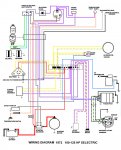
Before I leave, I'll ask---do you have a wiring diagram? Anybody who attempts to repair the motor will need one. So, I am posting one. About that blocking diode: Looking at the diagram, you will see a purple/green stripe wire leading between the shifting switch to the main terminal strip on the motor. If you know electrical circuits, you will realize that if that purple/green wire is shorted to ground, excessive current will flow through the blocking diode. Looking further, you will see that the purple/green wire connects to the shift diodes, rectifier, alternator, and clipper circuit. See what I mean about being a complex system?
OK, I'm going to make one last comment. Well, more than one. It seems there are several issues here. The chief ones being it won't run, and the diode getting hot. Can we assume the starter is rotating the engine flywheel? If not, that is another issue. And yes indeed, you have to take one issue at a time. Start with the most potential for being the most expensive one. That would be get it running. I fully respect your inexperience and lack of knowledge of how all this stuff works. But without extensive teaching, I don't know how to help with that. I had to go to school to learn it. My advice is seek someone who does have the training and pay him for what he knows. If you don't feel it is worth that, then it is time to get rid of this motor, and get one that is operational and doesn't need fixing.
Before I leave, I'll ask---do you have a wiring diagram? Anybody who attempts to repair the motor will need one. So, I am posting one. About that blocking diode: Looking at the diagram, you will see a purple/green stripe wire leading between the shifting switch to the main terminal strip on the motor. If you know electrical circuits, you will realize that if that purple/green wire is shorted to ground, excessive current will flow through the blocking diode. Looking further, you will see that the purple/green wire connects to the shift diodes, rectifier, alternator, and clipper circuit. See what I mean about being a complex system?

 I will continue to update as it is being fixed and conclusions for other readers.

 . I need to go shred water already
