1977 1150 Exhaust Cover Leaking

tavacska

Petty Officer 1st Class
Joined
Jan 21, 2017
Messages
247
I dealt with one broken bolt for a long time. Finally I managed to tap an enlarged one on the hole.

But when I replaced the new gasket and torqued to the specification of 21.5 ft.lb.

The exhaust cover leaks a lot from every where. However the engine starts good, runs good, as low as 650 rpm. But the more rpm, the more water comes out from exhaust gasket, bolts. I guess maybe the baffle/cover part is sealed good?

I did the job with cleaning surfaces with Gasket Remover spray, carefully with a razor. I am sure, not much scars left on the surfaces. Then with a new set of gasket. I did not use any sealer since the manual does not mention any.

What could be wrong? I have a Permetex Form a Sealer, which I used it one the Crank block cover. Should I also used in on the surface of baffle/cover?

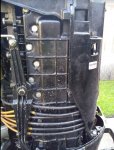
Attached is the picture of leakage. Some bolts even has stream spilled out when it runs at 1700 rpm.

Thanks.
 

Attachments

  • Capture.JPG
    Capture.JPG
    105.6 KB · Views: 6

Chris1956

Supreme Mariner
Joined
Mar 25, 2004
Messages
28,545
Hard to tell from the picture. Are all the leaks coming from bolt heads? Those covers do rot out from the inside and can leak anywhere. Obviously the fix in that case is replacement.

If leaking from the bolt heads and seams of the cover, I do not think you have any other choice but to use some sealant. I would coat the gaskets with it and reinstall. If it is really bad, silicone is a possible answer. If not too bad, peremetex #2 may work.

Using silicone, coat the gasket and install boats loosely. Let silicone set up a bit, then torque the bolts down....
 

tavacska

Petty Officer 1st Class
Joined
Jan 21, 2017
Messages
247
Thanks, Chris,

The leak is out from everywhere, the bolts, and the side gasket places. At least 7 bolts has leaks out.

I replaced that gasket first, then fixed the bolt for a week, then reuse the gasket again for the test. The gasket seems to be loose after the first use. Is that the problem?

And I torque the bolt really hard, replace many bolts to stainless steel bolts. To 21.5 lb.ft, is that too big? because there is some wear off from the hole. There is no washer used there, because it was not used before. But I plan to use it later, because I found there is a tiny crack line already around the bolt hole on the cover plate. But water does not come from that.

When I do research online, some said the gasket should have self-sealant on surfaces. Maybe right, because when I took off the plate, some gasket would stick to the surface.

One more thing, the cover plate leaks the first time when I replaced them. But at that time, there is one bolt missing and it leaks the same bad as now, So I thought it is because of the missing one broken bolt. But seems truth is it should be the gasket's problem.

I will check with silicone thing, thanks.
 

tavacska

Petty Officer 1st Class
Joined
Jan 21, 2017
Messages
247
Here is also a link to the leaking video.
The gasket is not self-sealant, maybe that's the reason it leaks so much.
 

Chris1956

Supreme Mariner
Joined
Mar 25, 2004
Messages
28,545
Stainless steel bolts are not as strong (grade 2) as the originals. I would replace with original grade of bolts., likely grade 7.

Check exhaust baffle for flatness. See if it will bolt straight.

Water pressure is not much. Silicone applied to exterior of cover may seal it. Same with bolt holes. If you have leakage on end of plates, you will need to silicone cover gaskets.
 

Sea Rider

Supreme Mariner
Joined
Sep 20, 2008
Messages
12,345
Were both mating surfaces immpecable clean and even to be 100% smooth when rubbed with finger ? If not, will need to sand with medium grade metal sanding paper till both surfaces are smooth and even for gasket to sit and seal as needs to be.

Strange those bolts heads don't use a flat washer under them, all OB's that have seen has them. Personally would install them and torque al bolts to specs. All gaskets needs to be retorqued soon after the OB has worked for 10 hours, Gaskets compresses and needs to sit back as were originally torqued to or will moisten gasket area or even leak in the short run.

Happy Boating
 

tavacska

Petty Officer 1st Class
Joined
Jan 21, 2017
Messages
247
Were both mating surfaces immpecable clean and even to be 100% smooth when rubbed with finger ? If not, will need to sand with medium grade metal sanding paper till both surfaces are smooth and even for gasket to sit and seal as needs to be.

I rechecked the surface and found out some black points are not soot but the left gasket, although it feels smooth. I sanded the surface by grit 220, not very hard, only to show a little more metal. I will buy some washers to install them tonight.

I got some Permatex High Tack Gasket Sealer, with a brush on cap. It says to withstand up to 500F. I will use that first on gasket to see if it works.
 

tavacska

Petty Officer 1st Class
Joined
Jan 21, 2017
Messages
247
The gasket sealer applied. No leak happens on edges.
But water still spill out of the screws, a lot!

There are cracks around several screw holes on the outer cover. Although it is tiny with bare eyes, I believe it will be enlarged under the screw pressure.

The manual says exhaust manifold cover is 21.5 lb.ft. So I guess I am using the right torque for the bolts. But bolts cracked the hole around it and water can come out only around bolts now.

The leakage looks the same as the videos above, except there is no leak on edges. I think the gasket sealer does work, it is very tacky.

I have bought a used set of covers to replace, have to wait another week.


Don't remember who gave me the advice from here last year, "If the exhaust doesn't bother you, leave it be if I were you".
Should have taken the advice. I have taken out the exhaust just because the manual says so and I have the gasket on hand.
 

Chris1956

Supreme Mariner
Joined
Mar 25, 2004
Messages
28,545
Put some silicone around the bolt heads and let it dry. That should stop the leaks.

In the future, it is best to let sleeping exhaust covers lie....
 

tavacska

Petty Officer 1st Class
Joined
Jan 21, 2017
Messages
247
Put some silicone around the bolt heads and let it dry. That should stop the leaks.

In the future, it is best to let sleeping exhaust covers lie....

The new used cover and new set of cover is ordered. I am going to use Permatex Ultra Black RTV Silicone this time, as pointed out by Jonheron on some posts about the water jack.

I disassemble the exhaust part again, many hole around the outer cover ask some kind of crack thread, it can enlarged if I push it by hands. That's the main reason for water leaking.

But, But, why there is water inside the exhaust baffle? I checked the flatness of the middle plate and block surface, it's not waffled. And the surfaces of gasket and metal are all well coated with the Permatex High Tack Gasket Sealer. But there is still water coming into the baffle.

One more thing, the inner baffle area and outer water jacket should not have much pressure, right? Is 21.5 lb.ft too much for the bolt torque? I have doubt on this because I think it's the bolt torque that crack the bolt holding holes.
 

Chris1956

Supreme Mariner
Joined
Mar 25, 2004
Messages
28,545
First of all, are you lower crankshaft seals good? These will allow water into the bottom two cylinders. Maybe this is what you are seeing.

Change them now, while the block is off the midsection. Install 3 seals, if you can get them to fit. You do have the block on the bench, right? Much easier to get exhaust cover on right.

Bolts should be torqued to correct spec for grade of bolt. Merc originally used grade 5 or 7 steel bolts.
 

tavacska

Petty Officer 1st Class
Joined
Jan 21, 2017
Messages
247
First of all, are you lower crankshaft seals good? These will allow water into the bottom two cylinders. Maybe this is what you are seeing.

Change them now, while the block is off the midsection. Install 3 seals, if you can get them to fit. You do have the block on the bench, right? Much easier to get exhaust cover on right.

Bolts should be torqued to correct spec for grade of bolt. Merc originally used grade 5 or 7 steel bolts.

The lower seals I believe good, it's no broken, still like new, which I replaced last year. The bolts spec I really have doubt on, the pics below show the cover crack because of intense bolts torque.

Is this cover still reusable? Someone says the JB weld can seal the crack. The seller on Ebay canceled my order, but I have a new set of gasket now. Anyone has experience on this?
 

Chris1956

Supreme Mariner
Joined
Mar 25, 2004
Messages
28,545
I see two cracks in the bolt holes. One leads in and the other out. I do not think JB weld is the answer.

I would put sealer on the gaskets and assemble the exhaust cover, leaving the bolts loose. Now, put some silicone around the shaft of the bolt and wait 15 min. Now crank them in to torque value in two steps.

The torque sequence is from the center to the outside, alternating between up and down. So tighten the center row of bolts. Now tighten the one row up from center and follow up with the bolt row one down from center. Repeat until you get 'em all.
 

Chris1956

Supreme Mariner
Joined
Mar 25, 2004
Messages
28,545
I also do not think it is too long before your waterjacket cover springs a leak from corrode thru...
 

tavacska

Petty Officer 1st Class
Joined
Jan 21, 2017
Messages
247
I see two cracks in the bolt holes. One leads in and the other out. I do not think JB weld is the answer.

I would put sealer on the gaskets and assemble the exhaust cover, leaving the bolts loose. Now, put some silicone around the shaft of the bolt and wait 15 min. Now crank them in to torque value in two steps.

The torque sequence is from the center to the outside, alternating between up and down. So tighten the center row of bolts. Now tighten the one row up from center and follow up with the bolt row one down from center. Repeat until you get 'em all.

Thanks Chris, you have helped me with most of my questions also in other posts.

Let me make a procedure on this, which I will follow through. Please correct me if I am wrong.

1. Use permatex Ultra Black RTV silicone gasket maker/sealer.
2. Put THIN layers silicone on both gasket and contacting surfaces
3. Put some silicone to the cracks from inside, better sand off corrosion first and then put silicone on.
4. Assemble the exhaust cover, leaving the bolts loose.
5. Now, put some silicone around the shaft of the bolt and wait 15 min.
6. Now crank them in to torque value in two steps.The torque sequence is from the center to the outside, alternating between up and down. So tighten the center row of bolts. Now tighten the one row up from center and follow up with the bolt row one down from center. Repeat until you get 'em all. The spec says 21 ft.lb, but I will use 200 in.lb, which corresponding to 5/16 grade 5 steel bolts. (The attached link shows the manual, first column is L6, second is V6).
7. Sand crack from outside, put silicone on to seal the cracks.


My other questions.
1. I have never used silicone. The water spilled like stream from the cracks before. Can it seal the cracks good? I saw Youtube people will do the propane torch + aluminum rod to fix some aluminum holes. I don't know if that works too for these small cracks. I am afraid the heat can make the cover wobble. I am asking this, because I am really tired of dis-assemble and assemble the power head, which will take me 3-4 hours at least to get it ready for test. I have done it 4 times.

2. On air intake manifold, should the gasket also use silicone to seal. I didn't do any sealer on it. What torque should I use according to the manual?

3. On cylinder manifold, should the gasket also use silicone to seal. I didn't do any sealer on it.
 

Chris1956

Supreme Mariner
Joined
Mar 25, 2004
Messages
28,545
It is very hard to weld aluminum. Especially corroded aluminum. I expect the covers will get more screwed up if you try it.

The water pressure of the water jacket is not very much. I expect silicone to work pretty well. I would fill the cracks from the inside and outside.

Your motor is 40+ years old. Use silicone whereever it leaks. I would expect the cylinder head cover to leak as well.

When you say air intake manifold, do you mean crankcase cover? I would use grease on the cork seal. Usually the carb mounting flanges do not leak, if you use new gaskets.
 

tavacska

Petty Officer 1st Class
Joined
Jan 21, 2017
Messages
247
I mean the by-pass manifold.
I already take off every cover.
I have sanded the exhaust cover crack area, when I do the sanding, I found over 10 crack almost on every hole. It must be the torque cracking them all.
I will assemble them all tonight using silicone, by-pass cover, cylinder cover, and exhaust cover.
The ultra-black silicone RTV says 1 hour sit on and then torque on, I will wait 30 minutes because of the temperature. Then another 24 hours to test.
 

tavacska

Petty Officer 1st Class
Joined
Jan 21, 2017
Messages
247
I tried to use a lot silicone on the cover. And it does help a lot for the outside leaking. Although there is still small leaks, but I believe a little fix here and there will make it a good to go.

Fortunately, I have found a used set of manifold online which is like almost new. So I pulled the engine again and dissemble the exhaust cover. Can someone tell me, is there any water inside the baffle plate? Where is the leak?

I cannot tell by myself.

Thanks.
 

tavacska

Petty Officer 1st Class
Joined
Jan 21, 2017
Messages
247
I replaced the new exhaust baffle plate and exhaust outer cover with new two gaskets. Applied ultra black on each side.
Now the outer leaking is gone, with only a drop or two on one screw, a little bit ultra black will easily fix it.

I run it for 20 mins and then check the spark plugs. All the compression is 120, 120, 130,125,125, (#6 too tight, not available). The only #6 plug is shining clean and has milky.

I have two suspicions:
1. The middle gasket between block and middle part. I didn't put sealant on it and I use only 4 bolts to tight it down for future easily removing again. There maybe leak from there to the exhaust part and then go into cylinder?

2. I changed the upper and lower crankshaft seals too. For lower part, I didn't replace it , but only added a new seal ring on top of the existing twos. Some said if there is leak in these seals, water can be sucked in and to the lower cylinders. Is that possible?
 
Top