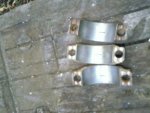
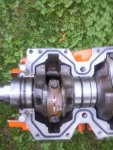
Nice work. But I thought the piston was at the bottom of the stroke when the rod passes the reed block, and the ports are open. Nothing is going through the reeds at that time.

I guess in my simple way of thinking that just weakens the rod.

I second that. Unless the end's of the slots were drilled, that's a man made crack.
Just throwing this out there, but is there any thought that the slots may allow more oil out then in?
that was a thought i had also......that mod could could starve the rods of oil. but running the motor under load will tell the tale.
irrespective the whole idea of it is for the bearing to get more lube in & that's one way of doing it , as Ive seen many bearings on these models fail due to not enough lube, cheers
I have seen many of those motors with bearing failures too. But they were caused by water, an issue that you have already addressed very impressively. I have never seen a bearing failure due to lack of oil---assuming the oil was even in the gas. But I will admit that it seems like you guys down there in New Zealand seem to be a lot harder on motors then we are here.
BTW, you are not the first to put oil slots in the rod caps. The factory did it too, on some models. But before heat treating. I wonder, how did you cut that stuff? I'm impressed by your ability to do stuff.
durban, when is he motor going to be reassembled and tested?

Interesting topic and an interesting experiment. I'm not sure what model motor you're working on, but motors with fully jewelled crank and rods, don't have a real issue, when it comes to oiling, that I have ever heard. The purpose of the needle bearing setup, was to reduce the need of oil mix in the fuel. With the needle bearing set up, the friction has been removed from the crank and rods by a huge amount. Now the main part that may suffer is the pistons. Unfortunately, there's not a whole lot that can be done, to make the pistons a "non-friction" part of the motor, like what has been accomplished with the crank and rods.
What I think would be a real interesting experiment, is for someone to build a hot rod engine for their dragster, with the needle bearing crank and rods, like these slow running outboards have. Of course, you would have to put flow restrictors on the lower end, so the valves don't suffer.
It is a 1975 70hp model 70ESL75B, its nearly 37yrs old i bought it for 50dlrs , all in bits & pieces opened it up & found the bottom bearing cooked there weren't even rollers left in the bearing cage they seem to have disintegrated , the crank i went & sold at scrap metal the piston has got very very slight marks on its more than likely caused by heat lucky no score marks in it . I looked for any signs of water that may have come through the bottom port couldn't find anything so i suspected bottom carb caused the damage , they have since been given my utmost attention & then i decided to mod the con-rods whether it,s gonna work or not , who knows your guess is as good as mine . However Suzuki has got it in there con-rods . I do this sort of thing just for the love of it , when i am finished with this motor its gonna run for another 40yrs . Saturday going fishing ,cheers
What I think would be a real interesting experiment, is for someone to build a hot rod engine for their dragster, with the needle bearing crank and rods, like these slow running outboards have. Of course, you would have to put flow restrictors on the lower end, so the valves don't suffer.
With a pressurized lubrication system, the bearings theoretically should not be making contact with the surface of the crank in a running engine (they are separated by a film of oil). IMHO, needle bearings present in these engines would increase friction and heat, as they are always in contact with the surface of the crank. The other possible issue is the amount of force placed on the needle bearings when someone were to say do a hole shot with a manual transmission and slicks. Allot more force being applied directly to the bearings (no cushion of oil) than say an outboard being placed into gear at a low RPM and accelerating only as fast as the prop can bite the water. There is something to be said for hydraulic pressure.
i sort of agree ,but not quiet the viscosity of the oil in a 2stroke motor is a big factor , combustion etc however i will try & mix the fuel with Shell SAE 10 & see what happens the motor may run smoother due to a change in viscosity , who knows ?