
Re: Durbans radiator con progress
no worry , i spent 4 years at technical collage for diploma in engineering , the motor so far runs at about 2000 rpm through 10lts of fuel , so some thing must be working so far , cheers
Ole Evinrude only had a 3rd grade education, BUT- he did apprentice in a machine shop and study math, mechanics and engineering in his spare time and was a born inventor. You have the born inventor part in great measure.
The math and science stuff (like thermodynamics) are merely tools to use to make the invention part easier and quicker.
Unfortunately, there is a paradox involved. In the process of gaining all of the math and science and engineering knowledge, in many cases the inventiveness (creativity) part is greatly reduced or stunted through the education process. Most engineers are not inventors on a large scale.
That said, your particular large problem is to get a great amount of heat from one place (the motor) to another place (the air or the ocean). You are using water or a water/glycol mix to move the heat around. "X" Watts of heat from the motor need to get moved from the motor, into the water, into the radiator, and exchanged into the air. If you know the volume of water (and pressure and velocity; all related) moving through the radiator you can figure out how much heat is exchanged with the air at different ambient temperatures and with different air flows (also a velocity/volume problem) through the radiator.
As to the real problem you're trying to solve, the "salt water motor slowly dissolves over time" problem, I currently run 3 motors over 40 years old that ran in salt water at least 25 years. The secret to that was WD40 in a spray bottle by the gallon and faithful flushing with "Whaler's secret formula". Dawn dishwashing liquid.
Good luck, and keep up the inventiveness and curiosity!
no worry , i spent 4 years at technical collage for diploma in engineering , the motor so far runs at about 2000 rpm through 10lts of fuel , so some thing must be working so far , cheers


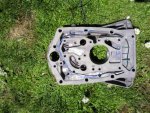
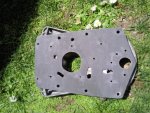
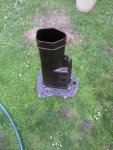
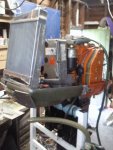
![100_2773[1].jpg](/data/attachments/148/148901-13a9a1ec8994c22ff06436b9e1238121.jpg)

