Fuel leaking out of the throttle (butterfly) shaft

Mc Tool

Commander
Joined
Aug 7, 2024
Messages
2,096
If your worried about that throttle shaft there are a few things you can do
1/ make some brass bushed , I got thin wall brass tube from a model engineers shop with the ID the same as the throttle shaft dia , and used a few drills to ream out the carb body . I actually hammered the drill right into the body on one side and used the point of the drill to center it on the other side of the body , put the drill shank in the vise and rotated the carb body . It takes a nice clean sliver of metal out and with the correct sized drill used last the bush was a "press it in with your thumb" fit .
2/ find or make a thin plastic washer thats a tight fit on the shaft and assemble so that the washer bears against the carb body , this dont fix any slop but it does stop it from sucking air in . I saw a spring loaded version of this while bushing a carb but I cant remember which one , twas either a 390 cfm Holley or a weber 32/36 DGAV .
I had issues with an inconsistent idle but it was because ( I suspect ) due to shaft /body wear the edge of the throttle plate landed in a different position in relation to the idle transition orifices in the carb body .
 

Scott06

Fleet Admiral
Joined
Apr 20, 2014
Messages
7,648
If your worried about that throttle shaft there are a few things you can do
1/ make some brass bushed , I got thin wall brass tube from a model engineers shop with the ID the same as the throttle shaft dia , and used a few drills to ream out the carb body . I actually hammered the drill right into the body on one side and used the point of the drill to center it on the other side of the body , put the drill shank in the vise and rotated the carb body . It takes a nice clean sliver of metal out and with the correct sized drill used last the bush was a "press it in with your thumb" fit .
2/ find or make a thin plastic washer thats a tight fit on the shaft and assemble so that the washer bears against the carb body , this dont fix any slop but it does stop it from sucking air in . I saw a spring loaded version of this while bushing a carb but I cant remember which one , twas either a 390 cfm Holley or a weber 32/36 DGAV .
I had issues with an inconsistent idle but it was because ( I suspect ) due to shaft /body wear the edge of the throttle plate landed in a different position in relation to the idle transition orifices in the carb body .
His issue was fuel leaking by it, not a vacuum leak. There is no way slop in the throttle shaft will influence a fuel leak.
Bowl is spilling over so either too much fuel pressure or needle and seat /float.
 

Lou C

Supreme Mariner
Joined
Nov 10, 2002
Messages
14,589
I had the same thing on my Quadrajet about 15 years ago, it turned out to be the needle valve for the float, probably deteriorated by E10 gas. Ever since replacing it I have not had that problem again.
About the throttle shafts, I researched this as well and apparently on the Q-Jet it can be a problem too, but it will cause a vacuum leak and an unsteady idle. I tried to measure the vertical play on mine using a dial indicator with the throttle cable off, and I found it to be about .010", I have read that .020" is the limit on these, so no re-bushing needed as of yet....
 

Scott06

Fleet Admiral
Joined
Apr 20, 2014
Messages
7,648
I had the same thing on my Quadrajet about 15 years ago, it turned out to be the needle valve for the float, probably deteriorated by E10 gas. Ever since replacing it I have not had that problem again.
About the throttle shafts, I researched this as well and apparently on the Q-Jet it can be a problem too, but it will cause a vacuum leak and an unsteady idle. I tried to measure the vertical play on mine using a dial indicator with the throttle cable off, and I found it to be about .010", I have read that .020" is the limit on these, so no re-bushing needed as of yet....
Q-jet has a big problem with this . Any decent rebuilder will bush them as they will be better than new. only reason not to is if you are doing a trailer queen resto and you are using a NOS carb or low milage example. While it can happen with any carb generally the AFB/eddy/webber and the rochester 2 jets iot is not so much of an issue. generally on the 2 jet you replace the brass throttle shaft as the base is cast iron. Only very rarely does a 2 jet need a bushing.
 

Mc Tool

Commander
Joined
Aug 7, 2024
Messages
2,096
His issue was fuel leaking by it, not a vacuum leak. There is no way slop in the throttle shaft will influence a fuel leak.
Bowl is spilling over so either too much fuel pressure or needle and seat /float.
Yes I know that , at no point did I suggest that a loose throttle shaft was causing the leak :rolleyes:
 

Joshto

Petty Officer 2nd Class
Thread starter
Joined
Jul 29, 2019
Messages
123
Q-jet has a big problem with this . Any decent rebuilder will bush them as they will be better than new. only reason not to is if you are doing a trailer queen resto and you are using a NOS carb or low milage example. While it can happen with any carb generally the AFB/eddy/webber and the rochester 2 jets iot is not so much of an issue. generally on the 2 jet you replace the brass throttle shaft as the base is cast iron. Only very rarely does a 2 jet need a bushing.
It's driving me crazy. I've taken apart the carb a hundred times. I've checked and rechecked everything: float level and drop, power valve/washer, gaskets, needle/seat/gasket, idle mixture needle, and the plastic tube is clear... everything per the manual and attached bulletin. I'll measure the fuel pump pressure; it's the only thing left. At this point, I want it to be the fuel pump; otherwise, I'll throw the carb in the lake and get a new one.
 

Attachments

  • 79160139-Service-Bulletin-Mercarb-97-08.pdf
    49.2 KB · Views: 6

Joshto

Petty Officer 2nd Class
Thread starter
Joined
Jul 29, 2019
Messages
123
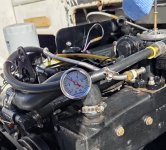
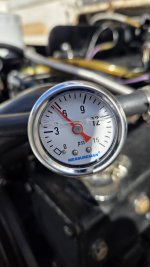
Update: I reinstalled the pump with the thick gasket (plus Perfect Seal) per the manual instructions. Reset the carb's idle mixture screw and idle screw pero manual too. Installed a DIY fuel pressure gauge and the pump is spot on.
Brought the engine to operating temperature, then kept it at 2500 rpms for about 5 minutes (didn't want to go above on the mufflers). Then back to idle, no flooding or dripping from the venturi at idle. Turn off the engine, no flooding, no dripping, and of course no fuel leaking through the butterfly shaft.

I don't know. Seriously. Next season I'll try again in the lake at regular cruising rpms (3800).

1793393663962.png

Idle (~800 rpm)
1793394166203.jpeg

~1800 RPM
1793393859761.jpeg
 

Joshto

Petty Officer 2nd Class
Thread starter
Joined
Jul 29, 2019
Messages
123
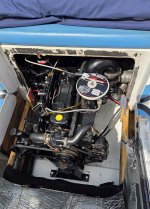
Thats a nice tidy clean looking motor :) Pleased that you got it sorted
I don't know if it's sorted, though...I mean, once I go on the water next year, I'll find out. I winterized the boat; it's going to storage tomorrow.

I take pride in this boat (when it works lol) and keep it shiny. I just installed a remote oil filter kit to make oil changes easier and cleaner.

1793395585986.jpeg

1793395659127.jpeg
 

Scott06

Fleet Admiral
Joined
Apr 20, 2014
Messages
7,648
Update: I reinstalled the pump with the thick gasket (plus Perfect Seal) per the manual instructions. Reset the carb's idle mixture screw and idle screw pero manual too. Installed a DIY fuel pressure gauge and the pump is spot on.
Brought the engine to operating temperature, then kept it at 2500 rpms for about 5 minutes (didn't want to go above on the mufflers). Then back to idle, no flooding or dripping from the venturi at idle. Turn off the engine, no flooding, no dripping, and of course no fuel leaking through the butterfly shaft.

I don't know. Seriously. Next season I'll try again in the lake at regular cruising rpms (3800).

View attachment 420807

Idle (~800 rpm)
View attachment 420813

~1800 RPM
View attachment 420810
that Fuel pressure is fine. Can only guess that the gasket Change made a difference in pump output pressure based on the results you saw ( fuel pressure is correct and you didn’t have fuel dripping). Seems to be correct at the moment.

one thing flare fittings don’t use thread tape. Generally thread tape is not a great idea on fuel systems as pieces of it can come off and become debris in the needle and seat etc . Better off using teflon paste or if you want some sort of thread lubricant or anti seize for future removal perfect seal/ permeatex #3 is an excellent thing to use on threads wether pipe or bolts for future removal ease. I think the late Don S on here brought that into common knowledge and something I picked up from this forum and continue to use moving forward
 

Joshto

Petty Officer 2nd Class
Thread starter
Joined
Jul 29, 2019
Messages
123
one thing flare fittings don’t use thread tape. Generally thread tape is not a great idea on fuel systems as pieces of it can come off and become debris in the needle and seat etc .
Yeah, I learned recently that SAE flare (inverted or not) does not need any sealant at all. The Teflon tape at the back of the thread is left from last year (I haven't taken it off), but every time I remove and reinstall the fuel line, I dont use anything at all, and it never leaks.
 
Top