FORUM RULES UPDATED - The forum rules have been updated to continue to provide a friendly and safe environment for our member community. Please take a moment to review the updated rules and our terms of use and privacy policy. Click here for Forum Rules which has links to the 'terms of use' and 'privacy policy'.
In Other News . . .
You will notice a few enchancements to the forums to make your experience better. These include: Email Notifications, Thread Previews, Thread Starter Notation, and Emoji Options on the 'Like' icon. . .
Additionally, the merchant portions of the website have been updated and are now operational. . . . Check out iBoats for all your boating gear.
It's good to pull the drive(s) one a year especially in salt water. You can grease the spline, u-joints, inspect the bellows and kind of makes sure the drive does not get stuck (corroded) on the transom assembly.
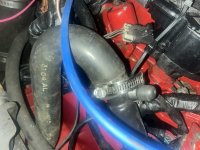
Hi all good advice. I tracked my leak to where this raw water line meets the transom. It’s hard to get to but I’m wondering if it is just loose or something
It`s hard to see a leak in the pic, but a leak anywhere on that hose would not be in conjunction with a bad bellows. The bellows could still be bad and need replacing but if you see water from that hose, it would not be bellows water.
That’s the hose for the raw water to enter through the transom in to the power steering cooler. I also have a small leak on the transom end of this hose, only when engine is off as the suction from the impeller will not allow water to leak when running. Water will drip from the hose barb onto the Y-pipe of the exhaust and into the bilge. Did you try to tighten the hose clamp(s)?
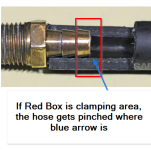
That is great got to the issue. And suggest some follow up: improperly placed clamps (as well as overnighted or wrong type of clamps) can cause premature hose failure. A clamp tightened straddling the hose bib like the mockup below can eventually cause a failure at that point (blue arrow). And lot of bibs cannot accommodate 2 clamps, unsure if this one can. Suggestion is to REMOVE that improperly placed clamp. Here is a good article on hose clamps in the marine environment: link.