No tach,no charging

Texasmark

Supreme Mariner
Joined
Dec 20, 2005
Messages
15,047
like Boscoe99 said

the yellow wires need to be disconnected from the RR when testing for AC to see if it is putting any AC voltage
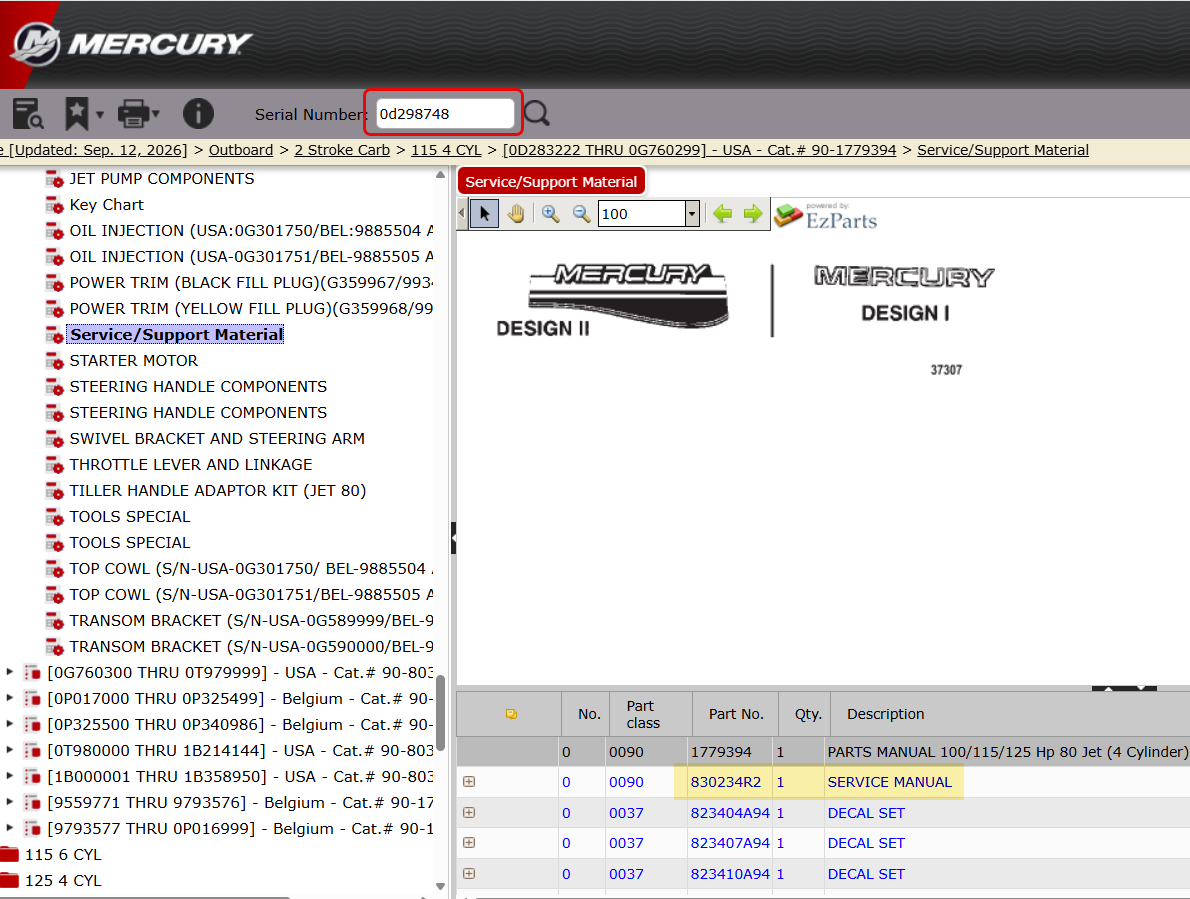
Er ah.....my Mercury manual says that if the Stator yellow wires aren't connected to a circuit....rectifier and load, or rectifier/regulator, the Stator is damaged. My guess is that the voltage rises to a very high voltage (with no load) and you have an arc-over in the Stator.....we addressed that in an answer above.
 

boscoe99

Commander
Joined
Aug 22, 2013
Messages
2,384
Er ah.....my Mercury manual says that if the Stator yellow wires aren't connected to a circuit....rectifier and load, or rectifier/regulator, the Stator is damaged. My guess is that the voltage rises to a very high voltage (with no load) and you have an arc-over in the Stator.....we addressed that in an answer above.
Can you copy and paste the snippet from the SM where that is stated?
 

Ifishmuskie2

Petty Officer 2nd Class
Joined
Oct 5, 2025
Messages
142
I put a new stator and regulator/rectifier on.
The engine runs great but
No change. Still no tach and no charge.
I ohm tested all the wires. Everything is good.
I guess the new regulator/rectifier is bad ?
I guess I’ll order a new one.

Any more help?
This would be sad if this ends my boating season .
 

Mc Tool

Lieutenant Commander
Joined
Aug 7, 2024
Messages
1,936
Er ah.....my Mercury manual says that if the Stator yellow wires aren't connected to a circuit....rectifier and load, or rectifier/regulator, the Stator is damaged. My guess is that the voltage rises to a very high voltage (with no load) and you have an arc-over in the Stator.....we addressed that in an answer above.
Yes that can happen but at a 60vac output from the coils .....well if it takes only 60v to push thru the insulation it pretty much knackered anyway ( and could be the real problem ). I use a 500v insulation tester on very similar coils on 3 phase 16vdc pwm motors and 300vdc motors ( both of which are often used to make power generators in home made applications) .
If the ends of the coils are un terminated there is no current flow .......there has to be a complete circuit ( thats why its called a circuit ) for current to flow . If there is an internal short in the windings ....even if it only a couple of coils this will act like a secondary winding in a transformer and usually get hot pretty quick .
 

Chris1956

Honorary Supreme Mariner
Joined
Mar 25, 2004
Messages
29,163
I do not believe that a stator will be damaged, if not connected to the VR or some load. In that case the stator is an open circuit, and no electricity will flow.

If the stator is grounded, current will flow. I do not know if this would damage a stator, and I think it would not.

Remember, Merc outboard have been blowing rectifiers for decades. Sometimes the rectifiers short to ground, yet, the stators are not usually damaged. Grounding the stator can cause issues on the ign power, as the coils for both share a common iron core.
 

Mc Tool

Lieutenant Commander
Joined
Aug 7, 2024
Messages
1,936
I do not believe that a stator will be damaged, if not connected to the VR or some load. In that case the stator is an open circuit, and no electricity will flow.
Yeah , thats what I think too
If the stator is grounded, current will flow. I do not know if this would damage a stator, and I think it would not.
again Yeah , but if one part of a winding is down to earth there would have to be another earthing point in the circuit like the reg/rect. Not all of them are , my wee Tohatsu has a charging coil but both ends of this coil go to the reg/rect , which is not earthed , and the output from the reg/rect is a 12v+ and a 12v- that go to a battery thats not connected to the motor . Battery only powers the GPS and my underwater light in my inflatable boat that I use for spotlighting flounders at night .
Remember, Merc outboard have been blowing rectifiers for decades. Sometimes the rectifiers short to ground, yet, the stators are not usually damaged. Grounding the stator can cause issues on the ign power, as the coils for both share a common iron core.
Just as an aside my insulation tester can be switched between 250 , 500, and 1000v ......and .... well you know how nosey cats can be :LOL::LOL:
 

boscoe99

Commander
Joined
Aug 22, 2013
Messages
2,384
Yeah , thats what I think too

again Yeah , but if one part of a winding is down to earth there would have to be another earthing point in the circuit like the reg/rect. Not all of them are , my wee Tohatsu has a charging coil but both ends of this coil go to the reg/rect , which is not earthed , and the output from the reg/rect is a 12v+ and a 12v- that go to a battery thats not connected to the motor . Battery only powers the GPS and my underwater light in my inflatable boat that I use for spotlighting flounders at night .

Just as an aside my insulation tester can be switched between 250 , 500, and 1000v ......and .... well you know how nosey cats can be :LOL::LOL:

Are you saying that because perhaps there is no standalone ground wire?

I am not aware of any R/R that does not have a ground of some sort.
 

Dukedog

Captain
Joined
Oct 6, 2009
Messages
3,552
Are you saying that because perhaps there is no standalone ground wire?

I am not aware of any R/R that does not have a ground of some sort.
lots of 'em on tha market at one time.. no wire, used case ground... maybe not so much now but they were......................
 

Mc Tool

Lieutenant Commander
Joined
Aug 7, 2024
Messages
1,936
On a smaller outboard not necessarily , as in my case with a plastic boat and a motor that does not require a battery to run but has a charging coil you would have to run a separate earth / neg to the battery . I could ground the reg neg wire to the motor.........:unsure::unsure: actually now that I think about it my reg might be grounded ....cant remember . Some regs are grounded via their mounts and some have a neg wire that you can put under a mounting bolt so you have the choice , mmmm cant remember what I did but the reg is a Temu special so its not a proper outboard reg .... probly aimed more at a small motorbike . But with bigger motors with a starter , power trim , electric choke( ? ) and other accessories ....like a car its probly easier to ground the batt neg to the cylinder block , but you still need to run a batt neg ( earth ) wire for any accessories up the front of the boat . AND I aint so sure that grounding the hull of an aluminium boat would be a good idea corrosion / electrolysis wise.
 

Chris1956

Honorary Supreme Mariner
Joined
Mar 25, 2004
Messages
29,163
Outboards as usually frame ground (or earth). That means the rectifier or VR will have the negative side of the battery and rectifier grounded. On Merc rectifiers, the negative side of the diode bridge is internally connected to the metal of the rectifier and when the rectifier is bolted to the frame, it is grounded. That is why Merc rectifiers have only 3 wire connections, vs standard rectifiers when have 4 connections.
 
Top