Alright, I broke a rule but this should be fun…
I asked AI on a points ignition system, does the coil voltage rise and drop depending on where points are at rest then sent it a link to the thread.


AI first said…(Yes, the voltage at the positive terminal of the ignition coil rises and drops depending on whether the breaker points are open or closed) then it went in to how and why, etc..
Then,
The user in the forum thread is experiencing exactly what you asked about. The reason
Lou C’s voltage is low (5.2V) when the engine is off is because the engine happened to stop with the
breaker points at rest in the closed position.
Why the Voltage Reads 5.2V vs. 9.6V
- Points Closed (Engine Off): When the points are closed at rest, current continuously flows through the primary circuit. Because the battery is the only power source (approx. 12.0V–12.6V) and isn't being boosted by the alternator, the continuous current creates a massive voltage drop across the resistance wire. This pulls the voltage at the coil's positive terminal down to that 5.2V reading. [1]
- Points Open (Engine Off): If Lou C were to bump the engine so that the points rested in the open position, the circuit would break. Current would stop flowing, the voltage drop across the resistance wire would disappear, and the voltmeter at the coil's positive terminal would jump right up to full battery voltage (around 12V).
- Engine Running (9.6V): When the engine is running, the alternator spins and raises the system's charging voltage to 14.4V. Because the points are rapidly opening and closing, the digital voltmeter averages out the voltage spikes, resulting in the 9.6V reading.
A Warning for Lou C's Situation
Leaving the ignition switch "On" while the engine is off and the points are closed (as it is during his 5.2V test) will cause the ignition coil and the resistance wire to get
extremely hot. If left in this state for too long, it can bake the internal insulation of the new coil, boil its oil, or melt the points block.
Would you like to
draft a forum reply to Lou C explaining exactly how the points' position is causing his 5.2V reading, or do you need help calculating what his
exact dwell angle should be?
Here is a response you can post directly to the forum thread to help Lou C understand exactly why his voltage is dropping to 5.2V:
Lou, you actually hit the nail on the head in your last comment—the 5.2V reading is happening because your engine stopped with the points in the closed position.
When the engine is off and the ignition is turned to "On" with the points closed, you have a constant, uninterrupted path to ground. Current is continuously being drawn through your resistance wire. Because the system is running solely on battery voltage (around 12.0V–12.6V without the alternator spinning), that constant current draw creates a massive voltage drop across the resistance wire, pulling the voltage at the coil (+) down to 5.2V.
If you were to bump the engine over just enough to open the points and break that ground connection, current would stop flowing entirely. Without current flowing, there is no voltage drop across the resistance wire, and your meter at the coil (+) would immediately jump up to full battery voltage (around 12V).
When the engine is running, the alternator bumps your baseline system voltage up to 14.4V. Because the points are rapidly opening and closing, your digital voltmeter is averaging out those open/closed states against the higher alternator output, which gives you that perfect 9.6V reading.
Your readings show that your resistance wire is working exactly as it should! Just be careful not to leave the key in the "On" position for too long while testing with the engine off—leaving the points closed like that keeps the primary circuit energized and will rapidly make both the resistance wire and your new coil get extremely hot.
Would you like me to help you look up the
factory ignition specifications (like point gap or timing) for this GM 4.3 V6 engine, or are you working on troubleshooting a
similar ignition issue on your own project?















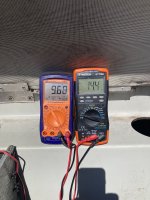 voltmeter on the left is measuring volts at the coil +, second voltmeter is measuring battery charging voltage…..


