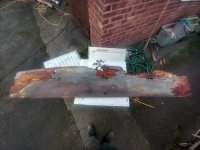
Swap wood panel in upholstery

Lpgc

Petty Officer 1st Class
Joined
Jun 17, 2023
Messages
379
I think im caught up so rather than poly, which is a surface coating that may Crack and then allowing water in and to be more trapped, I would choose to mix up the old timers formula that has been mentioned. It soaks in rather than a top coat. I am absolutely not the expert so take my statements at your peril...

Hehe, I read Tpenfield's description of the formula, read another description I found on this forum a few years ago which also said polyurethane... What's in the old timers formula instead of polyurethane (is it regular oil/solvent based varnish)?

I've already bought the poly stuff but I can get the classic oil/solvent based yacht varnish easily and inexpensively if it would be better...?
 
Last edited:

redneck joe

Supreme Mariner
Joined
Mar 18, 2009
Messages
14,195
Again not the expert but I do know from use, it soaks in not surface. Im a woodworker so know poly very well. The added two ingredients do something to allow all of it to soak in rather than surface coat.
 

redneck joe

Supreme Mariner
Joined
Mar 18, 2009
Messages
14,195
The "Old Timers Formula" refers to a traditional wood-sealing mixture (spar varnish, boiled linseed oil, mineral spirits/turpentine) for boats, working by creating a deep, penetrating, and durable finish that protects wood from water, rot, and UV rays, with oil & spirits allowing deep soaking, followed by varnish for sealing. It works by penetrating wood fibers, strengthening them, and then creating a hard, protective shell, making it effective for sealing plywood and bare wood on boats and outdoor projects.
How it works:
Penetration: The mineral spirits (or turpentine) thin the spar varnish and linseed oil, allowing the mixture to soak deep into the wood's pores.
Strengthening: The linseed oil nourishes and hardens the wood fibers from within, adding flexibility and preventing brittleness, as described by forum users on Reddit.
Sealing: After the penetrating mixture dries, multiple coats of straight spar varnish are applied to create a tough, waterproof, and UV-resistant surface.
The classic recipe:
Ratio: 1 part Spar Varnish : 1 part Boiled Linseed Oil : 2 parts Mineral Spirits (or Turpentine).
Application: Apply until the wood stops absorbing, let dry, sand lightly, then apply 2-3 coats of regular spar varnish on top, notes a Reddit thread.
UV Protection: If exposed to sun, an oil-based paint should go over the varnish, as UV breaks down spar varnish.
 

Lpgc

Petty Officer 1st Class
Joined
Jun 17, 2023
Messages
379
The "Old Timers Formula" refers to a traditional wood-sealing mixture (spar varnish, boiled linseed oil, mineral spirits/turpentine) for boats, working by creating a deep, penetrating, and durable finish that protects wood from water, rot, and UV rays, with oil & spirits allowing deep soaking, followed by varnish for sealing. It works by penetrating wood fibers, strengthening them, and then creating a hard, protective shell, making it effective for sealing plywood and bare wood on boats and outdoor projects.
How it works:
Penetration: The mineral spirits (or turpentine) thin the spar varnish and linseed oil, allowing the mixture to soak deep into the wood's pores.
Strengthening: The linseed oil nourishes and hardens the wood fibers from within, adding flexibility and preventing brittleness, as described by forum users on Reddit.
Sealing: After the penetrating mixture dries, multiple coats of straight spar varnish are applied to create a tough, waterproof, and UV-resistant surface.
The classic recipe:
Ratio: 1 part Spar Varnish : 1 part Boiled Linseed Oil : 2 parts Mineral Spirits (or Turpentine).
Application: Apply until the wood stops absorbing, let dry, sand lightly, then apply 2-3 coats of regular spar varnish on top, notes a Reddit thread.
UV Protection: If exposed to sun, an oil-based paint should go over the varnish, as UV breaks down spar varnish.

Thanks, was just about to ask if you meant the oil formula used traditional oil/solvent based spar / yacht varnish.
 

Lpgc

Petty Officer 1st Class
Joined
Jun 17, 2023
Messages
379
Hmm, I don't know whether to use the linseed, polyurethane varnish and mineral spirits mix or use the linseed, traditional varnish and mineral spirits mix now lol.

I don't want to start any arguments hehe but I'll ask @tpenfield again and anyone else who might be able to help me decide, all info/comments welcome.

Starting to think I might be overthinking it, I reckon my dad would've just varnished it and not thought twice about it if he were doing the work 20 years ago on one of his boats. In contrast I've spent hours researching how to protect a piece of exterior grade plywood in an unimportant none structural bit of boat trim that would probably outlast me even if I didn't protect it lol.
 
Last edited:

tpenfield

Moderator
Staff member
Joined
Jul 18, 2011
Messages
18,871
What ever you come up with, it will probably work fine . . . not really rocket science.

I've used varnish, and I've used polyurethane. It will take a few days to dry, so plan your timing accordingly.
 

Lpgc

Petty Officer 1st Class
Joined
Jun 17, 2023
Messages
379
What ever you come up with, it will probably work fine . . . not really rocket science.

I've used varnish, and I've used polyurethane. It will take a few days to dry, so plan your timing accordingly.

Thanks.

OK last question on the mix of stuff for protecting the wood lol.. Which of the two mixes would you use and why? I was originally going to use epoxy and bought some but was reminded that it'd probably be too hard to staple to if I used expoxy. Then I was told about the 3 part boat mix and I thought it'd be easier to apply and staple to but didn't realise there were a few different ideas about what 1 of those 3 parts should be.
 

JASinIL2006

Vice Admiral
Joined
Feb 10, 2012
Messages
5,749
I’d use the polyurethane rather than traditional varnish. Any solvent-based poly should work. I treated a transom board for a small aluminum boat with the old timers formula (poly-mineral spirits-boiled linseed) and it really does soak into the wood much better than a surface application of polyurethane alone.
 

Lpgc

Petty Officer 1st Class
Joined
Jun 17, 2023
Messages
379
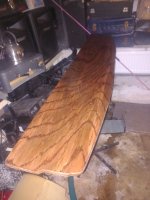
I've just given it the first coat using 1/4 boiled linseed oil, 1/4 polyurethane varnish (oil based) and 1/2 mineral spirits mix. I don't know if old-skool none poly oil based varnish would've been better but I'd already bought the poly varnish.

Done it in the 'cellar', what you'd probably call the basement. It's not really a cellar or basement, the house is built on a hill so it's taller at the front that at the rear, the 'cellar' is really just an above ground storage area half full of old audio equipment, vinyl records, etc. I'm doing it down there because it's heated, even if it is full of cobwebs and probably a few rats finding their way in and out, seemed easier to do it there than make a heated area in the garage. I was a DJ for a long time (kind of a moonlight job) and my dad was a singer / guitarist in bands most of his life, there's still some of his old gear down there too.

And soak end grain three times as mich. Capillary action and all....

Yes, I expected that and it's definitely soaking in a lot more at the ends of the ply than on the top and bottom.

I only mixed a pint because the panel is only approx 6ft x 1ft, I haven't applied it all yet but it seems to be soaked as much as it'll take. I've been keeping it wet with the old timers mix to the extent it's dripping on the floor.

I should probably ask what technique you're supposed to use to apply it... I probably shouldn't have been keeping it so wet? It isn't soaking in as quick as I expected, maybe not far off what I expected on the end grain but a lot slower on the top and bottom than expected. I'm not too bothered if there are runs on the finish because it's a piece of wood that's going to be hidden with foam and vinyl so I erred on the side of keeping it wet. Any tips?

I removed fittings / Tnuts before applying and was a bit concerned about whether the old timers mix would seal screw holes or holes made by Tnut spikes making it difficult to refit them without messing up the wood around the holes but I don't think that'll be a problem?
 
Last edited:

tpenfield

Moderator
Staff member
Joined
Jul 18, 2011
Messages
18,871
You seem to be over thinking things. I usually just slobber the stuff on and go on the the next thing. :LOL:

BTW - don't tell anybody, but I've used Thompson's Water Seal when I was out of poly or varnish.
 

Lou C

Supreme Mariner
Joined
Nov 10, 2002
Messages
13,846
PS
I used PT wood when I did the big sunpad on my 88 F/W and nothing else, it's still good! Done 17 years ago!
did the same when I fixed the port side coaming panel like 8 years ago.
 

Lpgc

Petty Officer 1st Class
Joined
Jun 17, 2023
Messages
379
Thanks for all the comments :)

I know I'm over thinking it lol

I saw some Thompson's WaterSeal in a couple of local hardware shops and nearly bought some instead of using Old Timers mix.

How long is the Old Timers stuff supposed to take to go off? It's around constant room temp in the cellar but it's cold, wintery and humid outside...

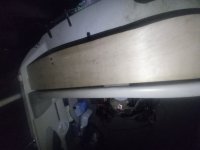
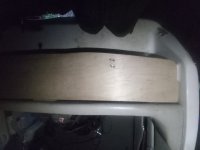
Couple of pics

20260117_190233.jpg

20260117_190254.jpg
 

redneck joe

Supreme Mariner
Joined
Mar 18, 2009
Messages
14,195
Up until I 'retired' a couple weeks ago i was doing handyman work and that is many times a trade off with quality to effort (money spent) especially since the majority of my customers were my age or older. Many of the conversations around the solution options I proposed was 'we will all be dead before this is a problem again'. That is how I approach life now.
 

redneck joe

Supreme Mariner
Joined
Mar 18, 2009
Messages
14,195
Should not. I actually tried (and posted here) with an attempt to make that happen. If you do try put out in the driveway like I did.
 
Top