Water in exhaust manifolds

chartersj

Petty Officer 1st Class
Thread starter
Joined
May 14, 2013
Messages
288
Before winterizing this year I decided to pull the risers on my 5.7 efi open cooling, to check the gaskets, and found a little water in the bottom of both exhaust manifolds. I boat in salt water, flush it on the hose after every use, and the water in the exhaust manifolds was fresh water.

The gaskets appeared decent, but changed them out and put it back all back together with new spark plugs. Ran it on the hose for 15 minutes. I then pulled the risers again to have a look, and there is water in both sides again.
I also pulled the plugs, no evidence of water in the cylinders, but a couple of the plugs were much darker then the others.
And the engine oil is clean, starts easily and seems to run great.

Just wondering where else I should be looking at for water intrusion?
 

Lou C

Supreme Mariner
Joined
Nov 10, 2002
Messages
14,500
What did the sealing surfaces look like on the manifolds and elbows? Any pitting, loss of material due to corrosion, etc?
That's what often starts a wet joint design leaking, the sealing surfaces get deteriorated from salt water corrosion.
They should look like this:
New exhaust on OMC V6 with longer bolts for alignment.jpg
this is the OMC/Volvo style wet joint but Merc is similar....
 

chartersj

Petty Officer 1st Class
Thread starter
Joined
May 14, 2013
Messages
288
What did the sealing surfaces look like on the manifolds and elbows? Any pitting, loss of material due to corrosion, etc?
That's what often starts a wet joint design leaking, the sealing surfaces get deteriorated from salt water corrosion.
They should look like this:
View attachment 420387
this is the OMC/Volvo style wet joint but Merc is similar....
There was a little pitting on them. I cleaned the surfaces up good and I used a gasket maker with the gaskets as well. And showed no signs of water getting by when inspecting
 

Lou C

Supreme Mariner
Joined
Nov 10, 2002
Messages
14,500
You know that some gaskets get gasket sealer but some do not. Which did gaskets you use? I know Volvo has specific instructions on what to use with their gaskets, what does Merc say?
Also, as a general thing you should always measure the flatness of the sealing surfaces with a straight edge and feeler gauges, all the way around. It should be flat with no more than .003" variation. Any dips, or low points, more than that can cause the gasket to not seal. Some of them are bad out of the box, and have to be re-surfaced if you want them to seal.
Another thing some people miss, if the threads in the manifold aren't cleaned out, the bolts may bottom out before they actually apply full torque to the elbow and then to the joint. Clean them out and run a thread chaser through them and then clean them again. Makre sure the bolts will thread all the way in before installing.
 

Bondo

Moderator
Staff member
Joined
Apr 17, 2002
Messages
71,538
Before winterizing this year I decided to pull the risers on my 5.7 efi open cooling, to check the gaskets, and found a little water in the bottom of both exhaust manifolds. I boat in salt water, flush it on the hose after every use, and the water in the exhaust manifolds was fresh water.

The gaskets appeared decent, but changed them out and put it back all back together with new spark plugs. Ran it on the hose for 15 minutes. I then pulled the risers again to have a look, and there is water in both sides again.
I also pulled the plugs, no evidence of water in the cylinders, but a couple of the plugs were much darker then the others.
And the engine oil is clean, starts easily and seems to run great.

Just wondering where else I should be looking at for water intrusion?
Ayuh,...... How much water,..??
 

Lou C

Supreme Mariner
Joined
Nov 10, 2002
Messages
14,500
If you just have it idling on the water hose on a cool day, the exhaust might not even get up to 100*F, so a small amount of water can be condensation in the exhaust, just like what comes out of your vehicle tail pipe on short trips that don't heat up the exhaust enough to evaporate out the moisture. I took pix of the inside of my exhaust elbows with an inspection camera and you can see this clearly, on one side there isn't really water but little tiny rust bits that were probably drops of condensed moisture. Can't say that's what you have but it could be. On mine the port side runs cooler so that's the side with a bit of condensation...
port side (cooler)
exhaust port side.jpg
starboard side (warmer)
exhaust staboard side.jpg
I do this at the end of each season to check for leaks. Saves a lot of time.
 

chartersj

Petty Officer 1st Class
Thread starter
Joined
May 14, 2013
Messages
288
You know that some gaskets get gasket sealer but some do not. Which did gaskets you use? I know Volvo has specific instructions on what to use with their gaskets, what does Merc say?
Also, as a general thing you should always measure the flatness of the sealing surfaces with a straight edge and feeler gauges, all the way around. It should be flat with no more than .003" variation. Any dips, or low points, more than that can cause the gasket to not seal. Some of them are bad out of the box, and have to be re-surfaced if you want them to seal.
Another thing some people miss, if the threads in the manifold aren't cleaned out, the bolts may bottom out before they actually apply full torque to the elbow and then to the joint. Clean them out and run a thread chaser through them and then clean them again. Makre sure the bolts will thread all the way in before installing.
Good points. I’m not sure what merc says in that regard but I’ve changed riser gaskets in my old boats before and never had an issue. Last one had dry joint which I liked a lot.
I did put a straight edge along them and “looked” OK,,, but 0.003 is small lol.
And I torqued to 33ftlbs and didn’t feel any bottom out. Maybe I’ll keep an eye out this winter for a nice set
 

Lou C

Supreme Mariner
Joined
Nov 10, 2002
Messages
14,500
I wonder if you can convert yours to the dry joint if/when you need to replace the manifolds? If so I would. Much better design!
 

chartersj

Petty Officer 1st Class
Thread starter
Joined
May 14, 2013
Messages
288
I wonder if you can convert yours to the dry joint if/when you need to replace the manifolds? If so I would. Much better design!
Yeah that would be the thing to do. I will definitely look into that
 

chartersj

Petty Officer 1st Class
Thread starter
Joined
May 14, 2013
Messages
288
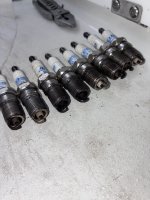
Figured I’d show what the brand new plugs looked like after the 15 minute run
If you just have it idling on the water hose on a cool day, the exhaust might not even get up to 100*F, so a small amount of water can be condensation in the exhaust, just like what comes out of your vehicle tail pipe on short trips that don't heat up the exhaust enough to evaporate out the moisture. I took pix of the inside of my exhaust elbows with an inspection camera and you can see this clearly, on one side there isn't really water but little tiny rust bits that were probably drops of condensed moisture. Can't say that's what you have but it could be. On mine the port side runs cooler so that's the side with a bit of condensation...
port side (cooler)
View attachment 420394
starboard side (warmer)
View attachment 420395
I do this at the end of each season to check for leaks. Saves a lot of time.
I have been meaning to get myself a cheap borescope
 

Attachments

  • IMG_3266.jpeg
    IMG_3266.jpeg
    1.6 MB · Views: 0

Scott Danforth

Grumpy Vintage Moderator still playing with boats
Staff member
Joined
Jul 23, 2011
Messages
53,246
You have 3 plugs that have been steam cleaned

Borescopes are about $11 from Amazon

Any putting on the gasket surface is bad
 
Top