Weird overheating issues

Backyardmech

Seaman Apprentice
Joined
Aug 4, 2020
Messages
38
I have a 2001 vp 5.0gl. It recently overheated due to bad impeller and raw water pump. After replacing the raw water pump and while running on the internal water hose directly to the raw water pump the water flow through the exhaust would stop and all the water would divert through the lower water intake ports in the out drive. Significant water was in cylinder 3 so I pulled the heads and one head gasket was blown. I took that head to the machine shop and they found that it was cracked. I replcace the head with a one rebuilt by the machine shop. After installing that head with new gaskets and thermostat everything seemed fine. Water flow out of the exhaust was good at idle and medium rpm. After doing several cycles medium rpm for a few minutes and idle with the temp fluctuating between 150 and 165 I let the engine at idle for about 20 minutes while I was looking for hose leaks and listening for odd sounds. While poking around a hose felt too hot and the temp guage read 200°. I shut down immediately.

Tldr.
What could cause the temp to spike after idling for 20 min after being cycled between med rpm and idle for about 30 min with no overheating issues? All on internal fresh water hose directly to to raw water pump.
 

alldodge

Moderator
Staff member
Joined
Mar 8, 2009
Messages
44,126
Connect a short clear piece of hose between thermostat and hose coming from pump. Boat needs to be in the water and your looking for bubbles
 

Lou C

Supreme Mariner
Joined
Nov 10, 2002
Messages
14,086
Often when one of these engines overheats, not only do the blow head gaskets but they will crack the heads. On some engines (I had this happen) they can overheat and then seem fine for a few seasons, but sooner or later the head gasket fails. I had that happen (water in a cylinder) 3 seasons after an overheat, when I took it apart I took both heads to the machine shop and both had cracked valve seats in the center cylinders (4.3 V6). So based on that and the fact that with saltwater use, the cooling passages were getting pretty eroded, I replaced the heads with a pair of reman cyl heads. Put it back together with Fel Pro gaskets and ARP cylinder head bolts and it is still running well now 9 years later. The best test is the one described above, where you run clear hoses from the thermostat housing to the exhaust manifolds, if you see bubbles coming with the water after the engine warms up, you are getting exhaust gas in the cooling water. Problem is, even if you do that, you still don't know the exact cause, it could be a blown head gasket (depends on where it blew) or a cracked head or a cracked block. You still have to take it apart!
I rigged up a way to do it on the water hose, it has to be done fast because the way I did it, engine isn't getting as much cooling water as normal but the manifolds are, I removed the thermostat temporarily to allow max recirculation of water. This was like 10 years ago so I may have forgetten some of the details. Watch it to the end, when I turn the engine off, you see bubbles in both funnels, that is exhaust getting into the cooling water, I knew it was at least head gaskets. In this case I didn't have water in the cyls where the cracks were but in the end, the answer is the same, finding the cause requires a full tear down.

if you can do a test in the water it is a much better test.


the cure:
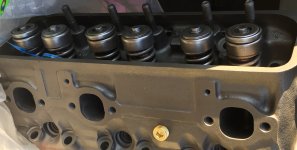
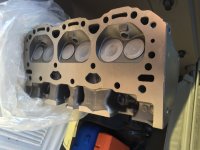
4.3 reman cyl head 1.JPG
4.3 reman cyl head 2.JPG
 
Top