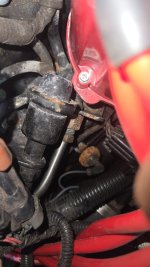
What is the part number for this regulator?

CLi87

Petty Officer 1st Class
Joined
Sep 21, 2018
Messages
230
Hey all, i'm working on my 2000 Mercruiser 7.4 MPI and ran into a low fuel pressure condition, when I turn key on engine off pressure spikes to about 40 psi then drops down to 18 psi, with engine running at idle pressure is about 28 psi. I figure the fuel pressure regulator may have failed and I'm not too familiar with this vacuum based regulator system. From what I can see there's a fuel pressure regulator right above the fuel pump and a vacuum hose connected to it that goes to a T connector, one end of the T goes to the intake plenum and the other end goes to some sort of other regulator. I plan to replace both regulator but I can't seem to find the part # for the regulator off the T that's right next to the distributor in any parts diagram?

This is the diagram i'm using:

In the diagram it just shows B -> to fuel rail pressure regulator and I checked the diagram for the fuel rail/intake plenum and the regulator isn't shown on that diagram either?
 

Attachments

  • 20260419_154118.jpg
    20260419_154118.jpg
    1.2 MB · Views: 6

Scott Danforth

Grumpy Vintage Moderator still playing with boats
Staff member
Joined
Jul 23, 2011
Messages
52,347
test the regulator before trying to replace it.

test the fuel pump output by itself.
 

CLi87

Petty Officer 1st Class
Joined
Sep 21, 2018
Messages
230
How would you go about testing the regulator and fuel pump? I have the cool fuel system and the whole setup is in an assembly box that's real tight, not sure how I could get any connector in between the parts to test
 

Scott Danforth

Grumpy Vintage Moderator still playing with boats
Staff member
Joined
Jul 23, 2011
Messages
52,347
The manual covers testing the regulator and pump. I would follow the manual
 

CLi87

Petty Officer 1st Class
Joined
Sep 21, 2018
Messages
230
The manual covers testing the regulator and pump. I would follow the manual

I have the service manual for the 7.4 MPI and in the diagnostic flowchart it just says check for fuel pressure and if not correct, go to "OBD Check", then doesn't have any instructions that I can find after that.
 

Scott Danforth

Grumpy Vintage Moderator still playing with boats
Staff member
Joined
Jul 23, 2011
Messages
52,347
unplug the vacuum line to the regulator. fuel pressure should spike to about 50 psi.

if the fuel doesnt spike, look at the pump or the plumbing
 

CLi87

Petty Officer 1st Class
Joined
Sep 21, 2018
Messages
230
unplug the vacuum line to the regulator. fuel pressure should spike to about 50 psi.

if the fuel doesnt spike, look at the pump or the plumbing
Ok, I assume this is with engine running and not just key on engine off? I'll do the test hopefully tomorrow if I have time to make it out to the boat, and what would be a test to check if the regulator is bad?
 

Lpgc

Chief Petty Officer
Joined
Jun 17, 2023
Messages
425
I'm not too familiar with marine applications but you seem to be describing a simple mechanical fuel pressure regulator setup similar to what is/was fitted on a wide range of vehicles.

Such regulators that have the vacuum connection maintain fuel pressure relative to engine manifold pressure... So if you use a standard pressure gauge the pressure should rise and fall inline with manifold pressure. If the engine isn't running there's no manifold vacuum so the gauge should read higher than when the engine is running at idle. At flat out there's very little manifold vacuum so a gauge should read similar to what it reads with the engine flat out.

If pressure falls away when the engine is turned off then maybe the regulator is allowing fuel to return to the tank, or the fuel pump is allowing some reverse flow, or a fuel injector is leaking.

I believe Scott means to check pressures when the engine is idling... If you disconnect the vacuum connection when the engine is idling then gauge pressure should increase by the same difference between manifold pressure and atmospheric pressure. If the ignition is on and engine not running, take a gauge reading, start the engine and let it idle, take another reading, the second reading should be lower because fuel pressure is referenced to the manifold pressure.

Of course the pressure should be what it should be, if it's lower or higher than it should be that could also be a regulator problem.
 
Last edited:

CLi87

Petty Officer 1st Class
Joined
Sep 21, 2018
Messages
230
Unplugging the vacuum to the regulator is the test.

I ran the engine and pulled the vacuum line when it was at idle, fuel pressure only went up from 28psi with line connected to 34psi with the vacuum line removed from the regulator.
 

Lpgc

Chief Petty Officer
Joined
Jun 17, 2023
Messages
425
I do a lot of work on fuel systems (on vehicles) but usually work in bars rather than psi or inches or water etc.

If we say 1 bar is close to atmospheric pressure, most warmed up engines idle with around 0.3bar (0.7bar vacuum) but a cold engine might idle at closer to 0.5bar manifold pressure. If we say 1 bar is around 14.7psi then we can easily work out that 0.5bar would be 7.35psi and 0.3bar would be 4.41psi. On most fully warmed up engines (that idle at 0.3bar) I would expect gauge pressure to increase by 10.29 psi when I disconnected the vacuum reference pipe. On an engine that idles with 0.5bar manifold pressure I would expect to see a 7.35psi increase when I disconnected the vacuum reference pipe. If you're seeing a change from 28psi to 34psi that is only 6psi difference which is less than I'd expect.. But that still doesn't say whether any problem is in the pump (maybe the pump is broken and maxes out at 34psi) or the regulator (if the pump is OK maybe the reg isn't properly adjusting pressure to keep pressure constant above manifold pressure). I don't know the spec of the engine, a big cam etc would increase warm and cold idle manifold pressure. Maybe the engine idles with 0.4 manifold pressure when warmed up and idles with 0.6 manifold pressure when cold, if that were the case (and you tested with cold engine) it would mean the reg was working properly (14.7 x 0.4 = 5.88psi). If you have a different vacuum pump (other than the engine) you have another way to test the regulator. In fact, if you have a small pressure pump (bike pump etc) you can pressurise the reg's 'vacuum' pipe to test both the regulator and pump.
 
Last edited:

Scott Danforth

Grumpy Vintage Moderator still playing with boats
Staff member
Joined
Jul 23, 2011
Messages
52,347
I ran the engine and pulled the vacuum line when it was at idle, fuel pressure only went up from 28psi with line connected to 34psi with the vacuum line removed from the regulator.
with only 34 psi with the vac line removed from the regulator. the regulator is fine. your pump is weak
 

Lpgc

Chief Petty Officer
Joined
Jun 17, 2023
Messages
425
with only 34 psi with the vac line removed from the regulator. the regulator is fine. your pump is weak
Worth either putting positive pressure on the vac line to the regulator or clamping the fuel return pipe from the reg back to the tank (or trying both)? With that done if the pressure increases it could still be the reg at fault, if the pressure doesn't increase it is the pump at fault.

Mechanical pressure regs are used on some turbo/supercharged engines, the objective (to keep fuel pressure as close to constant above manifold pressure as possible) is still the same but turbo/supercharged engines can have the manifold under vacuum or positive pressure, an atmospheric pressure reference would just be somewhere between. Inside the reg there's a spring pushing one way and the vacuum reference pulling against the spring pressure.... If the spring goes weak or there's some internal leak that allows fuel to get through to the return pipe despite the spring / vacuum balancing act part of it working OK a reg can still give symptoms that could be interpreted as the pump not delivering enough pressure when the vacuum pipe is open to atmospheric pressure.
 
Last edited:

Scott Danforth

Grumpy Vintage Moderator still playing with boats
Staff member
Joined
Jul 23, 2011
Messages
52,347
the VP regulator is a GM variant of the ones used in 2001-2008 in trucks. its just a slightly higher pressure version.
1776883211093.png
 

Fun Times

Moderator
Staff member
Joined
May 16, 2009
Messages
9,311
Because there are two of them for the marine version the regulator you found on top of the engine is more so considered to be a fuel injector 'fuel rail pulse damper vs regulating the psi like it does on the GM trucks that used the L29 engines in the late 90's...Merc basically left it in place vs removing it and then came up with their own regulator version down below.

It's hard to make out but the regulator is there in the overall parts catalog you linked which is item number 5 of a different area but that regulator is crazy expensive even if you wanted to chance using :oops:an aftermarket version of using Merc's, Volvo's, etc. part number that can be found on say Amazon, eBay, local parts store, etc.. The one on top generally doesn't go bad per se, but that doesn't mean it can't cause issues too especially should something other than fuel reach it but maybe try to make it a last resort if costs are an issue as again, it rare to cause issues.


^ Now with $ sticker shock set in and would still like to change it because of age, etc., being it's still a GM part, the following would be of more affordable OEM type options out of rock auto, GM dealers, Etc..
802630T01, 8M0069803 = GM 19245530
  • Complete OEM & Aftermarket Interchange: Interchanges with Mercury 802630, 802630T, and 8M0069803; Volvo Penta 3861279, 3857703, 3861268, 3808522, 23806259; Crusader 49063; and Sierra 18-7663.
  • MPI V-8 Marine Applications: Commonly used on MerCruiser/Mercury 7.4L (L29 / 496 MAG) and 8.1L MPI engines, as well as Volvo Penta and Crusader applications that reference the same regulator family.
9
GM 19245530 =
WELLS 5G1070 Info
$61.79
qty_down_white.png
ACDELCO 2173299 Gold Info
$62.79
qty_down_white.png
qty_up_white.png
STANDARD MOTOR PRODUCTS PR217 Info
$65.79
qty_down_white.png
qty_up_white.png
GM GENUINE 2173073 Contains Regulator 25324252 and Retainer 25179285; Side Vacuum Port Info
$71.99
qty_down_white.png
 

CLi87

Petty Officer 1st Class
Joined
Sep 21, 2018
Messages
230
Because there are two of them for the marine version the regulator you found on top of the engine is more so considered to be a fuel injector 'fuel rail pulse damper vs regulating the psi like it does on the GM trucks that used the L29 engines in the late 90's...Merc basically left it in place vs removing it and then came up with their own regulator version down below.

It's hard to make out but the regulator is there in the overall parts catalog you linked which is item number 5 of a different area but that regulator is crazy expensive even if you wanted to chance using :oops:an aftermarket version of using Merc's, Volvo's, etc. part number that can be found on say Amazon, eBay, local parts store, etc.. The one on top generally doesn't go bad per se, but that doesn't mean it can't cause issues too especially should something other than fuel reach it but maybe try to make it a last resort if costs are an issue as again, it rare to cause issues.


^ Now with $ sticker shock set in and would still like to change it because of age, etc., being it's still a GM part, the following would be of more affordable OEM type options out of rock auto, GM dealers, Etc..
802630T01, 8M0069803 = GM 19245530
  • Complete OEM & Aftermarket Interchange: Interchanges with Mercury 802630, 802630T, and 8M0069803; Volvo Penta 3861279, 3857703, 3861268, 3808522, 23806259; Crusader 49063; and Sierra 18-7663.
  • MPI V-8 Marine Applications: Commonly used on MerCruiser/Mercury 7.4L (L29 / 496 MAG) and 8.1L MPI engines, as well as Volvo Penta and Crusader applications that reference the same regulator family.
9
GM 19245530 =
WELLS 5G1070 Info
$61.79
qty_down_white.png
ACDELCO 2173299 Gold Info
$62.79
qty_down_white.png
qty_up_white.png
STANDARD MOTOR PRODUCTS PR217 Info
$65.79
qty_down_white.png
qty_up_white.png
GM GENUINE 2173073 Contains Regulator 25324252 and Retainer 25179285; Side Vacuum Port Info
$71.99
qty_down_white.png

Thanks! I'll definitely get one of those, can't believe they want over $500 for the OEM Mercruiser one, why is that one so much more expensive than the regulator on the fuel cooler?
 

CLi87

Petty Officer 1st Class
Joined
Sep 21, 2018
Messages
230
with only 34 psi with the vac line removed from the regulator. the regulator is fine. your pump is weak
I just bought a new fuel pump and it should be here Saturday so I'll install it and hopefully that fixes my problem, thanks!
 

Lpgc

Chief Petty Officer
Joined
Jun 17, 2023
Messages
425
If a fuel pressure damper goes wrong there are usually no symptoms unless it leaks.
 
Top