Swap wood panel in upholstery

Lou C

Supreme Mariner
Joined
Nov 10, 2002
Messages
13,846
Ah I don't know for sure but isn't that linseed oil REALLY flammable?
I think if I do another one of these (have to do the starboard side coaming panel next), I'm just going to use some oil based paint. Interlux Bilgecoat or similar. I used that on wood panels in the engine compartment and they have held up well.
 

MikeSchinlaub

Chief Petty Officer
Joined
Jan 14, 2025
Messages
628
Ah I don't know for sure but isn't that linseed oil REALLY flammable?
I think if I do another one of these (have to do the starboard side coaming panel next), I'm just going to use some oil based paint. Interlux Bilgecoat or similar. I used that on wood panels in the engine compartment and they have held up well.
They use it to coat wooden fire truck ladders. I wouldn't worry too much.
 

Lpgc

Petty Officer 1st Class
Joined
Jun 17, 2023
Messages
379
There's no upholstery near it yet. I thought the concern was it could spontaneously catch fire during curing, not when it's gone off? I'll have got some drips on stuff in the surrounding area, plastic bags etc.

I left it to dry when the stuff was still runny and the occasional drip falling off it, should I have wiped the excess off before leaving it?

Other than preventing runs what's the point of wiping excess off then adding another coat? Doesn't this give similar results to leaving it coated thick on the wood and allowing it to dry?

Edit - I just read @redneck joe 's post #43 again which explains it. That makes sense, when this stuff has gone off apply straight varnish. But if I don't wipe off the excess it might never go off? I'd better go back to it now and try to wipe the excess off.
 
Last edited:

redneck joe

Supreme Mariner
Joined
Mar 18, 2009
Messages
14,195
I think, occasionally, so my thoughts are after about 24 hours it will have 'gone off' or cured or whatever your countrys term is and not wiping off excess could leave a coating that could Crack (aesthetic at this point) or impede staples and if left exposed just look like sh,t.
 

tpenfield

Moderator
Staff member
Joined
Jul 18, 2011
Messages
18,871
I'm not sure what this wiping off stuff is all about . . . the whole idea of the wood sealer is that it soaks into the wood. I usually just 'slobber' the stuff on and set it aside to dry out for a few days.

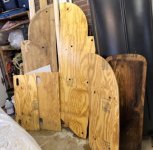
Here some pieces to my Formula 330 all soaked with the wood sealer and set aside to dry . . .
wood-pieces-2.jpg
 

Lpgc

Petty Officer 1st Class
Joined
Jun 17, 2023
Messages
379
But do you 'slobber' a 'wee bit'?


@Lpgc that is a joke from another thread, sorry but I had to....

Point me to the thread so I can have a laugh hehe.

I'm not sure what this wiping off stuff is all about . . . the whole idea of the wood sealer is that it soaks into the wood. I usually just 'slobber' the stuff on and set it aside to dry out for a few days.

Here some pieces to my Formula 330 all soaked with the wood sealer and set aside to dry . . .
View attachment 414270

Good, because I didn't wipe it off. When I came back to the wood yesterday it seemed too far set to wipe off without leaving it looking a smeary mess and as it seemed to be soaking up and setting anyway I didn't see the point in wiping off then adding more. It had definitely soaked in more on the end grain, I added more old timer stuff especially to the end grain where it'd soaked in most and applied some more all over the board. I have a customer arriving soon but I'll check the wood again when he's gone and expect to be adding more of the stuff, especially to the end grain.

If I mix some stuff and don't use it all will it keep for 24/48 hours until I'm ready to use it? I have some left over that I mixed yesterday.

Is the idea that after a few coats of this stuff and when it's all dried I should give it a coat of straight unmixed varnish?
 
Last edited:

redneck joe

Supreme Mariner
Joined
Mar 18, 2009
Messages
14,195
So really long thread but fun if you are into it. As mister Gump said I am not a smart man bit I can sorta follow the red bouncy ball.

What hit me was as Ted and others are calculating all their Einstein type formulas for swapping i/o to ob, he jumped in with moving something a 'wee bit'. A fing wee bit? Really?? We are talking about quarter million dollar project and 'wee bit' is an official calculation.... just too ripe not to poke at from this Tennessee redneck.

 
Last edited:

Lpgc

Petty Officer 1st Class
Joined
Jun 17, 2023
Messages
379
So really long thread but fun if you are into it. As mister Gump said I am not a smart man bit I can sorta follow the red bouncy ball.

What hit me was as Ted and others are calculating all their Einstein type formulas for swapping i/o to ob, he jumped in with moving something a 'wee bit'. A fing wee bit? Really?? We are talking about quarter million dollar project and 'wee bit' is an official calculation.... just too ripe not to poke at from this Tennessee redneck.

I've been watching Tpenfield's i/o to ob thread too, very interesting and he's a clever man. I'm probably a bit more familiar with 'wee bit' because it's a common Scottish saying and I'm British but I see the funny side of using exacting formulas and 'wee bit' about the same thing.

OTF soaks in so imo no need to top coat.
Thanks for that advice, heh it's the opposite of what I expected! I didn't initially realise others might mean it should have a top coat of varnish when it'd dried but later it seemed that's what they meant and I thought it'd be a good idea to give it a top coat(s) of neat varnish.

Would anyone else give it a top coat(s) of neat varnish or just consider it done after it's soaked up the old timer formula?
 

Lpgc

Petty Officer 1st Class
Joined
Jun 17, 2023
Messages
379
I knew I'd forgotten to do something... Make the drain / vent holes doh!

I've done that now, more of a faff making the holes with the old timer mix already on it than it would've been if I'd remembered to do it before applying the mix, with the mix on it it was pulling on the grain at the entrance and exit to the holes but it's not looking too bad. The endgrain has stopped soaking up the mix as quick as it was but now I have to put multiple coats in the new holes until it stops soaking in.

After putting the last coat of old timer mix on it (and it's set or slightly tacky) who would recommend giving it a coat of neat varnish and who would recommend leaving it as it is with just the old timer mix on it?
 

Chris1956

Supreme Mariner
Joined
Mar 25, 2004
Messages
28,576
A lot of times paint and varnish will not adhere to linseed oil.

e.g. My parents had cedar clapboard on their house in the 50's. It was treated with boiled linseed oil for some years. After that, they wanted to paint the clapboard. Even good oil based paint had trouble sticking to the surface. Giant bubbles formed everywhere, even after years of sanding scraping and repainting. They finally had it resided.
 

Lpgc

Petty Officer 1st Class
Joined
Jun 17, 2023
Messages
379
A lot of times paint and varnish will not adhere to linseed oil.

e.g. My parents had cedar clapboard on their house in the 50's. It was treated with boiled linseed oil for some years. After that, they wanted to paint the clapboard. Even good oil based paint had trouble sticking to the surface. Giant bubbles formed everywhere, even after years of sanding scraping and repainting. They finally had it resided.

I understand what you're saying and it makes sense, yet I've applied several coats of the old timer mix which is 1 part boiled linseed oil, 1 part oil based varnish and 2 parts oil based paint thinner (turpentine substitute, white spirit) and it is adhering to itself.. Since that mix is 1/4 varnish why would varnish not stick to the mix?
 
Top