











2001 Volvo Penta 5.0 GL cracked block

Laneman25

Petty Officer 3rd Class
Joined
Oct 24, 2023
Messages
75
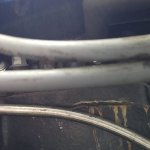
Wish I wasn't posting this but it happened. I would say that I carefully drain it each winter but obviously I didn't do something right. I have fond memories with the family on this boat. I always drain the two plastic plugs under the risers, both block drains, and the water pump. I also run a zip tie in and out of the drains to make sure all water comes out. The crack is T shaped just below the dipstick tube where yo see the water stains. Any chance of a JB weld or something, or is it toast?

 

Attachments

  • block.jpg
    block.jpg
    971.9 KB · Views: 11

Chris1956

Supreme Mariner
Joined
Mar 25, 2004
Messages
29,123
Gee, sorry that happened. Water is tricky and can get trapped in areas of the block. I always filled my block with straight automotive antifreeze for winter, since I was always uneasy about water hiding somewhere.

The good news is that rebuilt blocks are plentiful and relatively cheap. On MerCruisers, blocks are pretty easy to replace, once you get the hoist figured out. Hopefully V-P is the same.
 

Laneman25

Petty Officer 3rd Class
Joined
Oct 24, 2023
Messages
75
Well I've watched a few videos and several boat owners had long term success with JB weld. If anyone here has tried it please add some tips.
 

Lou C

Supreme Mariner
Joined
Nov 10, 2002
Messages
14,309
You also have to pull off the bottom of the big hose between the 'stat housing and the front circulating pump, did you do that?
GM cast iron blocks were never meant to be open cooled due to how cast iron rusts. So many rust flakes it is easy for passages to get clogged with rust flakes or even just sediment etc. from shallow water. I have a set of picks that I use to rod out the block drains each time I winterize it. When/if I repower my boat it is getting a half closed system for the block. Much better, easier to winterize and longer engine life.
One thing I noticed is this, it really helps to fill the block with the correct PG antifreeze for winter, because I have found that I rarely if ever have to poke one of the drains to get it to drain fully. It reduces corrosion when the boat is in storage, that's my opinion. And unlike many here, my use is 100% salt water. Block is original, heads were replaced 9 years ago (past overheat damage).
 

Laneman25

Petty Officer 3rd Class
Joined
Oct 24, 2023
Messages
75
You also have to pull off the bottom of the big hose between the 'stat housing and the front circulating pump, did you do that?
GM cast iron blocks were never meant to be open cooled due to how cast iron rusts. So many rust flakes it is easy for passages to get clogged with rust flakes or even just sediment etc. from shallow water. I have a set of picks that I use to rod out the block drains each time I winterize it. When/if I repower my boat it is getting a half closed system for the block. Much better, easier to winterize and longer engine life.
One thing I noticed is this, it really helps to fill the block with the correct PG antifreeze for winter, because I have found that I rarely if ever have to poke one of the drains to get it to drain fully. It reduces corrosion when the boat is in storage, that's my opinion. And unlike many here, my use is 100% salt water. Block is original, heads were replaced 9 years ago (past overheat damage).
Yes, pulled the big hoses from water pump
 

Lou C

Supreme Mariner
Joined
Nov 10, 2002
Messages
14,309
So then I’d guess there was some sediment in the bottom of the block passages that prevented all the water from draining.
 

Kosmofreeze

Petty Officer 3rd Class
Joined
Aug 23, 2023
Messages
82
I hope you can get some more life from your engine with JB Weld. However, when it comes time to sell, I don't really think that there is any difference between a cracked block and a JB welded block ... good luck.

I always cross my fingers every spring ... did I get ALL of the water out of the block? I always take a 5 gallon bucket of PINK antifreeze connected to the muffs on the final run until I see PINK out the exhaust. Then I drain the risers, block plugs and hoses. With the block plugs out and the impeller output hose disconnected at the top, I fill the hose with PINK until the PINK is running out of the block plugs. In my mind, I just filled the the block from the bottom up with PINK. Probably a belt and suspenders approach but I've made it through many northern Minnesota winters without incident. I just use the -50F stuff - when it gets cold, it'll turn to slush but very little expansion.
 

Lou C

Supreme Mariner
Joined
Nov 10, 2002
Messages
14,309
If you get to zero F use -100! -50 gets hard at that temp I tested it in the freezer. Spend the extra $$$
 

Kosmofreeze

Petty Officer 3rd Class
Joined
Aug 23, 2023
Messages
82
Fun Fact - Water is unique when it comes to common liquids in that it expands when frozen. This is what makes blocks crack. Even if your glycol or alcohol based antifreeze "gets hard" at below zero temps that doesn't mean that your block (or other components) are at risk of damage.

The coldest winter temp I've ever recorded at my house is -36F - never had a problem with the -50 stuff.
 

Lou C

Supreme Mariner
Joined
Nov 10, 2002
Messages
14,309
And those PG antifreezes are ok for plastic piping but for an unyielding cast iron block you definitely want something that will stay liquid.
 

Bondo

Moderator
Staff member
Joined
Apr 17, 2002
Messages
71,523
Wish I wasn't posting this but it happened. I would say that I carefully drain it each winter but obviously I didn't do something right. I have fond memories with the family on this boat. I always drain the two plastic plugs under the risers, both block drains, and the water pump. I also run a zip tie in and out of the drains to make sure all water comes out. The crack is T shaped just below the dipstick tube where yo see the water stains. Any chance of a JB weld or something, or is it toast?
Ayuh,..... For that reason, I keep a 4" ssteel deckscrew on my intake manifold,......
It's always there when I need it, 'n I believe a zip-tie is much to limp,....

Air don't freeze,......

Find yerself a 350 Chevy long block, 'n you'll be all set for the future,....
 

Lou C

Supreme Mariner
Joined
Nov 10, 2002
Messages
14,309
I have used West Marine -100 for years and when I can find it I buy Sierra PG coolant and mix it 50/50 with water. That gives freeze protection down to -26*F. I also tested it with the refractometer to be sure. The WM -100 tests to a freeze protection of -55*F. The -100 is a different rating for piping so that confuses people.
 

Lou C

Supreme Mariner
Joined
Nov 10, 2002
Messages
14,309
Ayuh,..... For that reason, I keep a 4" ssteel deckscrew on my intake manifold,......
It's always there when I need it, 'n I believe a zip-tie is much to limp,....

Air don't freeze,......

Find yerself a 350 Chevy long block, 'n you'll be all set for the future,....
Get one of those sets of small picks with the 90* tip I have dug out some old rust with it…
 

tpenfield

Moderator
Staff member
Joined
Jul 18, 2011
Messages
19,422
I'd go with a new (replacement) engine block. If the crack is on the outside, there is probably some damage (cracks) on the inside.
 

Chris1956

Supreme Mariner
Joined
Mar 25, 2004
Messages
29,123
I hope you can get some more life from your engine with JB Weld. However, when it comes time to sell, I don't really think that there is any difference between a cracked block and a JB welded block ... good luck.

I always cross my fingers every spring ... did I get ALL of the water out of the block? I always take a 5 gallon bucket of PINK antifreeze connected to the muffs on the final run until I see PINK out the exhaust. Then I drain the risers, block plugs and hoses. With the block plugs out and the impeller output hose disconnected at the top, I fill the hose with PINK until the PINK is running out of the block plugs. In my mind, I just filled the the block from the bottom up with PINK. Probably a belt and suspenders approach but I've made it through many northern Minnesota winters without incident. I just use the -50F stuff - when it gets cold, it'll turn to slush but very little expansion.
You realize that draining the block and manifolds and refilling them with A-F is all that is sufficient to keep the block from freezing. Running on the muffs with A-f introduced, doesn't hardly do anything, right? It simply mixes the A-F with the block water, which then you drain and refill.
 

tpenfield

Moderator
Staff member
Joined
Jul 18, 2011
Messages
19,422
The problem (mis-conception) with the 'pink anti-freeze via the muffs' is that a portion of the incoming anti-freeze goes directly out to the risers and does not go through the engine block. Therefore . . .

-> only about 3 gallons of the 5 gallon jug go to the engine block (and manifolds)
. . . and . . .
-> the 3 gallons of Anti-freeze that makes in into the engine mixes with the water that is previously in the engine block and manifolds.
 
Top