


It seems so. The trick is finding someone who knows how to do it and will take it on. I followed every lead I could find and they were all dead ends. And I live in the seattle/tacoma area, so I thought it would be easier.Milling machine and boring bar is the way to do them.-----Not that hard.

Thanks. I’m trying to set up a path to not just fix it(assuming I can get someone to rebore) but also to be aware of possible issues.Myself, I wouldn't even give those Reeds any concern.
Lean ness, Overheating, lack of Lubrication, and Detonation are some of the primary causes of Cylinder/Piston Problems.
How long have you had this Motor, and do you have the Service/Repair History of it?
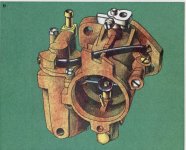

Not to highjack the thread, but genuinely interested and the information may be helpful to others as well. I plugged my hoses with a BB, but still have both ends connected. Is there any harm in not leaving the barb on the fuel bowl cover open?Cylinders 1&2 share a Carb, 3&4 share another, and 5&6 share the last one.
A leaky upper Crankshaft Seal can result in #1 running Lean
Hmm. You say it is an 80s motor? If so, it has what Mercury called the Back Drag Feature on the Carb, a way to improve Fuel Economy at Part Throttle. Works well, unfortunately, once Refineries started adding Alcohol to the Fuel, chemically leaning it, the mixture these Carbs deliver is actually too lean at Part Throttle. There is an easy Fix. There is a small black Hose running from the Carb Body, to the Fuel Bowl Cover. Remove the Hose from the Bowl Cover and push a small Ball Bearing into it to Plug it. You can leave the Barb on the Fuel Bowl Cover open as it just becomes another Bowl Vent
View attachment 416681
Thanks for the additional details on what it does. Ive got a lot of work to do, but will do this after i go through the carbsThe Hose provided a Vacuum Draw on the Fuel Bowl during part throttle operation, resulting in Less than Atmospheric Pressure on the Fuel in the Bowl, reducing how much Fuel was pushed into the Venturi. A Metered Orifice for the Bowl Vent prevented the Pressure in the Bowl from dropping too Low. Under further Throttle Opening, the Vacuum dropped off and Normal Atmospheric Pressure was restored in the Fuel Bowl.
Alcohol is not the only means of Chemically Leaning Gasoline, so Non-Ethanol Gas isn't being clear of the Issue. There was a Service Bulletin from Mercury instructing Shops to do what I had described
Do you use zinc plated grade 5? Is it a bad idea to use stainless with anti seize?Find bolts at your local hardware store.-----Replace the 5 bleed inserts if equipped with them.
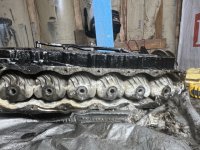
I have most of the pieces off. My head bolts were in terrible shape. I went really slow with lots of pb and heat but still have a broken bolt. This where I was considering stainless.Gee, the water jacket cover bolts are grade 5 or 7 steel in 1/4-20 or 5/16-18. Pretty common stuff at any HW store. Most of the trouble comes when the 1/4-20 water jacket screws break, when you try to remove them. I would skip replacing the cylinder heat water jacket gasket, unless you really need to. Sometimes the machinist needs the bare block. Ditto on the exhaust cover, baffle and inner exhaust cover. If they do not leak now, leave 'em alone.
Gaskets for your carbs are real cheap. Replace them.
If your floats are the old foam type, replace with the white hard plastic. The foam tends to dissolve in gasohol. Make sure the little springs are intact on the floats.
The inlet needles and seats should be stainless with neoprene tips, and the seats are all brass. If you have the old rubber and brass seats and nylon needles, replace 'em.
Unless your reeds are cracked or bent, they are likely fine. The originals hold up real well.
Replace end cap seals and crankcase seals. Reuse the shims under the upper end cap. Check the bearings in the endcaps for wear and replace as necessary.
Do a link and synch. 21* BTDC is max spark advance. ADI ignition calls for 0-9* ATDC for idle pickup. At idle pickup, the carbs must be closed, but ready to open.
Check the copper water tube for damage. Sometimes they get crushed by salt or silt. Replace the rubber seal that holds the water tube in the exhaust extension.
If you reuse pistons, make sure you get original style rings. Replacement pistons usually have 2 keystone rings, vs the 3 rectangular rings on the orig pistons.
I do mean the head-waterjacket. Those bolts were so funky. Way worse than any of the bolts on the water jacket over the exhaust cover.I think replacing the rod cap screws is very necessary. I did not do it after a rebuild of my Merc 1500, and she threw a rod. Although I did not open her up to see what failed, I suspect it was a rod screw.
If you hone some of the cylinders, and they are within spec, you could install new stock rings.
When you say head bolts, what do you mean? That engine doesn't have a removeable cylinder head. If you mean the water jacket cover over the cylinders, sometimes you can drill straight thru the casting and use a nut on the new bolt. The earlier models actually used nuts and bolts on the water jacket.
BTW, stainless steel bolts are about grade 2. They are not nearly as strong as the grade 5 steel bolts that came with the engine.