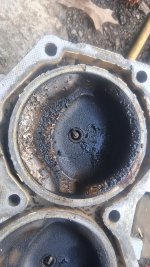
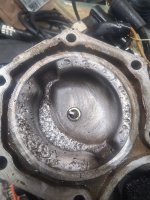
fwiw... here is a CHAT GPT diagnostic...
what would cause rough idle and difficulty to accelerate up to wot on a 1978 Johnson 140hp
On a
1978 Johnson 140 hp (V4 cross-flow, carbureted),
rough idle and poor acceleration to WOT are usually caused by problems in a few very specific systems. These motors are simple but
very sensitive to fuel delivery, ignition timing, and synchronization.
Below is a
priority-ordered diagnostic list, based on what most commonly causes exactly the symptoms you describe.
1. Fuel delivery issues (MOST COMMON)
A. Dirty or partially clogged carburetors
That engine uses
multiple carbs (2-barrel). If
one carb is lean, the engine will:
- Idle rough
- Bog or stumble when accelerating
- Sometimes run better near WOT (or never quite reach it)
Check:
- Low-speed jets and idle circuits (they clog easily)
- Float height (too low = lean bog)
- Sticking floats or needles
 Even if it “runs”, carbs that aren’t perfectly clean cause this exact symptom.
B. Weak fuel pump or air leak
- Cracked fuel hoses (especially original gray hoses)
- Weak or torn fuel pump diaphragm
- Loose hose clamps
- Air leak at fuel connector
Symptoms:
- Engine dies or bogs when throttle opens
- Must pump primer bulb to accelerate
- Primer bulb collapses at speed
2. Ignition system problems (VERY COMMON on late-70s OMC)
A. Cracked or failing ignition coils
OMC coils from this era often:
- Crack internally
- Misfire under load
- Idle roughly but rev OK unloaded
Check:
- Visible cracks or carbon tracking
- Weak or yellow spark
- Spark jumping to ground at idle
Replace as a set if original.
B. Bad power pack or stator (under load failure)
- Engine idles but breaks down when accelerating
- One cylinder may drop intermittently
- Timing may not advance correctly
Test:
- Check strong spark on all 4 cylinders
- Drop-cylinder test at idle
- Timing light while accelerating (see if advance moves smoothly)
3. Timing advance & throttle synchronization (CRITICAL)
If
carbs open before timing advances, the engine will:
- Fall on its face when you throttle up
- Idle poorly
- Never reach full RPM
Key checks:
- Timing advance linkage moves freely
- No sticking timer base
- Throttle pickup occurs after timing begins advancing
- WOT timing is correct (usually ~28° BTDC, verify for your exact model)
Incorrect sync is one of the #1 reasons these motors bog.
4. Dirty or restricted idle circuits (specific symptom)
If it:
- Idles rough
- Clears up slightly above idle
- Then bogs again under load
This almost always means:
- Idle air bleed clogged
- Progression holes blocked
These cannot be cleaned by spraying carb cleaner—
full disassembly is required.
5. Compression imbalance
Less common, but must be ruled out:
Check compression:
- All cylinders within 10% of each other
- Typically ~120–140 psi on a healthy crossflow
Low compression on one cylinder = rough idle + poor acceleration.
6. Reed valve problems
- Broken or chipped reeds
- Causes rough idle and weak low-speed response
Symptoms:
- Sneezing/backfiring through carbs
- Fuel mist blowing back out
7. Exhaust housing leaks (less common)
- Leaking exhaust gasket or tuner
- Causes loss of low-speed scavenging
Where I would start (efficient order)
- Compression test
- Spark test on all cylinders
- Carburetor cleaning & float check
- Fuel pump diaphragm inspection
- Ignition timing & throttle sync
- Check coils for cracks
Quick question to narrow it down
Does it:
- Bog immediately when you open the throttle, or
- Accelerate slowly but smoothly, or
- Miss/pop/backfire?
That single detail can pinpoint whether this is
fuel, timing, or ignition.
bogs quickly upon acceleration
A
quick bog the instant you open the throttle on a
1978 Johnson 140 hp is a
classic symptom on these motors. That narrows it down very well.
The MOST likely causes (in order)
1. Timing advance NOT starting before carbs open 
On this engine,
timing MUST begin advancing slightly BEFORE the throttle plates start to open.
If the carbs open first →
instant lean bog.
What commonly goes wrong
- Timer base sticking on the crank
- Dry or corroded timing linkage
- Misadjusted throttle pickup screw
- Worn cam follower
Quick test
- Remove the airbox
- Slowly advance the throttle
- Watch the timing arm:
- It should move before the carb plates begin to open
If carb plates move first → bog guaranteed.
This is the
#1 cause of snap bog on V4 OMCs.
2. Plugged idle / transition circuits in carbs
When you snap the throttle, the engine runs
entirely on the idle and progression circuits for the first second.
If even
one carb is partially blocked:
- Engine falls flat instantly
- May recover if you feather the throttle
- WOT might still be OK eventually
Typical clues
- Engine will accelerate slowly if you roll the throttle on gently
- Sneezing or coughing through carbs
- Rough idle
Fix requires
full carb disassembly, soaking, wire-cleaning of all idle and progression passages.
3. Weak ignition coils breaking down under load
Even if spark looks OK at idle:
- Coils crack internally
- Snap throttle causes instant misfire
- Engine bogs instead of revving
Check
- Look for cracks or black tracking lines
- Run in the dark and look for arcing
- Use timing light on each lead during acceleration
4. Lean condition from fuel supply problem
Less likely than timing/carb, but still common.
Check
- Primer bulb stays hard during snap acceleration
- Fuel pump diaphragm soft or torn
- No air leaks at connectors or hoses
If pumping the primer bulb
improves acceleration → fuel pump or air leak.
5. Sticking timer base (VERY common on older OMC)
Even if linkage looks fine:
- Timer base can stick suddenly
- Timing jumps instead of advancing smoothly
Test
- With engine OFF, rotate timer base by hand
- It should snap back freely
- If sticky → clean and lightly lubricate (OMC grease)
What I would do FIRST (10-minute checks)
- Remove airbox → verify timing moves before carb plates
- Snap throttle while watching timing arm (engine off)
- Pump primer bulb during bog test
- Look closely at ignition coils for cracks
Bottom line
Instant bog = timing or idle circuit problem, not main jets.
On a 1978 Johnson 140,
90% of the time it’s throttle sync or dirty idle circuits.


 .
.