Re: 1982 Glastron needs an engine!!
Location of motor mounts will all depend on what engine/drive combo you drop in. Engine mounts are normally part of, or attached to the "central" set of beefy stringers that are running on each side of the keel. The Volvo engines use the transom shield (via the bell housing) as the rear motor "mount" (some early Volvo actually was cantilevered of the transom shield w/o any front motor mounts).
Power trim is a GREAT feature, although it also introduces a few more items that can fail (and are expensive to repair - while eliminating the rickety electric tilt). But if you can find a VP transom shield with power trim, go for it.
Marine engines don't have a transmission in the traditional sense, but there is always (unless you have a variable pitch propeller) a transmission for reversing gears someone. On I/Os, that is as you say in the (out)drive. "True" inboards have it either in a "straight" (or close to) line with the propeller shaft, or in a "V-drive" setting (allowing the engine to rest further aft with "half" of the transmission in a straight line with the propeller shaft).
If you look in the diagram that Don posted in #9 above, you can see the differences in the cut-outs for the different transom shields. You can still run a 350 with a 280 drive. You just need to ensure you have the right gear ratio in the lower drive.
And, if you are new to this, please ensure you only use "marine grade" components when it comes to fuel system, starting system, charging system, as well as ignition system. Boats don't - as in a car - ventilate out the (potentially explosive ) fuel vapors, and with the right air/fuel vapor mixture in the bilge, it can easily go "pooof" - with disastrous results. Part from having marine grade components, you also need a "bilge blower" which is really a fan that "vacuums" out the heavier fuel vapors from deep in the bilge out in the open air. Blower should always be run for at least a couple of minutes before starting an engine, especially a gasoline inboard.
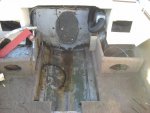
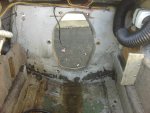
Post some photos of the interior, and based on what is seen through the transom hole, start with a a thorough cleaning out. Make ANYTHING some much easier to work with and many here can much better advise you on the condition of what you have to work with if some detailed photos are provided.
Since it looks like a bow rider, and if it has not been properly covered up over the years (1982 is a long away back...), I would REALLY start by checking for soft spots in the deck throughout the boat. I know it is much more fun to work on the "power" parts, but if you have a hull with "hidden" issues, you can do much better (for less money) if you find something that might already have an engine installed.
All that said, there are some truly amazing restoration projects in the "Boat Restoration, Building, and Hull Repair"
section of this forum. But to get there requires time, money, money, time, an understanding wife/GF/SO, and a decent space to work in (as an example, my trailer is too wide for my garage doors - not fun in the late fall when it would be great to park inside and "do" the boat).
Whatever you do, best of luck! Boats are fun, and we sometimes throw all sane reasoning out the window to proceed on our water bourne "projects"