



1982 Johnson Sea Horse 70hp "Overheating issue"

Troutrunn

Cadet
Joined
Aug 16, 2018
Messages
10
Hey all, I guess ill start from the beginning like every good story does. I had some extra cash and had been looking for a nice sturdy boat that would compare to my father in laws 17ft Mauntauk (whaler) has an 88 spl on it (Johnson). Its a very basic boat though in the bays and harbors its rugged and steady. So I found this Sea Ox 1983 17ft with a Johnson Sea Horse 70hp on it.

Bought the boat and towed home which was a nightmare in itself, Trailer rotten and decrepit. Hey I got a decent price I thought, a very expensive ferry ride from main land to Marthas Vineyard then back. $$$$$$$ Ticket was more than I paid for the boat!!!

110miles north and here I am with and over heating issue. let me state that I did do a bunch of research on my vessel and motor. I have found countless threads of people having issues and people still to this day loving their 40 something year old motors (Johnson Sea Horse 70hp). So I thought its a fifty fifty chance of this thing giving me problems after I go through the basic maintenance. So with that said I removed L.U. and ran through the water pump/impeller cleaned everything. From my little knowledge on this engine it was mainly run on the sandy shores of the CAPE. I.E. SALTWATER DUN DUN DUN!!!!!! Anyway I cleaned up the lower unit and replace all LU gear oil. removed and re greased prop shaft, I replaced wiring harness and Starter solenoid also replaced fuel pump, after installing a brand new Battery and a couple hours of messing with starter fluid and cranking it over. She fired up and Purred, I got to say I was pretty surprised with how well she came to Idle and stayed steady, I almost couldn't believe it. I throttle up and Rpms reved up I looked down at the prop it was spinning with smoke coming out. I was thrilled I let it run a couple min longer and then shut it off and walked away from it while I went back to work for the rest of the week. I came back to the engine today and started up fine and let run for 30 min or so between idle and up throttle, I forgot to state I am using Outboard Flushing Muffs hooked up to my well water (ill come back to this in a minute) I have a nice stream of steady water coming out of telltale and also when I rev up the engine the stream increases in power ( so does this mean my water pump and impeller and LU components are working and sending water up to at least the lower part of the block?) After a about 15 min or so I thought I heard a beeping sound like and alarm. I had dreaded this moment before I even got the thing running haha. Any way I am stuck. I removed thermostat housing and cylinder head case/water head case and ordered new gasket. Parts like little valve grommets and inside housing doesn't look so bad as in crusty or flaky but it was definitely Dry in there no water ran through that today. to confirm over heating I threw water from the hose on it and it boiled and fizzed also i noticed when i turned engine off the tell tale spat out quite a bit of steam. Also was smelling some burning paint. I never used a Temp gun and i do not have a temp gauge set up coming from this engine.


Please help!

Thanks J!
 

Troutrunn

Cadet
Joined
Aug 16, 2018
Messages
10
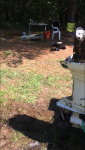
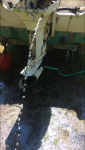
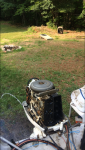
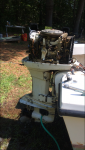
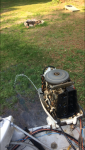
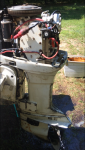
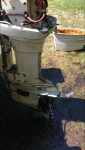
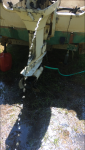
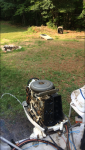
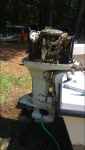
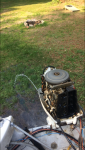
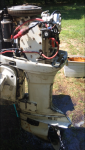
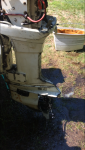
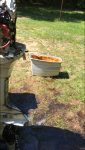
these Photos i captured from a video i took of the motor running at idle and then at half speed to demonstrate the water pressure coming from the telltale changing.
 

Attachments

  • photo298888.png
    photo298888.png
    1.3 MB · Views: 0
  • photo298889.png
    photo298889.png
    1.2 MB · Views: 0
  • photo298890.png
    photo298890.png
    1 MB · Views: 0
  • photo298891.png
    photo298891.png
    1.3 MB · Views: 0
  • photo298892.png
    photo298892.png
    1,014.7 KB · Views: 0
  • photo298893.png
    photo298893.png
    1.2 MB · Views: 0
  • photo298894.png
    photo298894.png
    1 MB · Views: 0
  • photo298895.png
    photo298895.png
    1.1 MB · Views: 0

Joe Reeves

Supreme Mariner
Joined
Feb 24, 2002
Messages
13,262
What is the model number of that engine.... small plate on side of left (port) transom bracket?
 

Joe Reeves

Supreme Mariner
Joined
Feb 24, 2002
Messages
13,262
There is no such number as JTOELCNB, Either you read wrong or the number was imprinted wrong. It should be... as you found... J70ELCNB which translates to:

J == Johnson
70 = 70hp
E == Electric
L == Long Shaft (20")
C == 8
N == 2 ...... CN = 82 (1982)
B == Factory run number, of no consequence.

OMC's code is the word "INTRODUCES" whereas each letter stands for a number.

For a engine to sizzle when you toss water on it... it has overheated to a point where "all" bolts, screws, bolts are normally loosened. Check spark plugs for traces of water, torque head bolts to factory specifications, tighten all other bolts nuts, screws.

The water pump is NOT a self priming pump. the water level must be higher than the pump area which is sitting on the lower unit's top mounting surface.... the water level must be at least 5" above that w/pump to upper housing mounting surface.

The warning horn will sound off with a steady constant beeeeeeep before the engine becomes hot enough to do any damage. Don't ignore that warning!

From what you've had to say, I'd suggest that you drop the lower unit, inspect the water pump, and at a minimum install a new impeller.

NOTE: A long paragraph such as what you entered is hard for us old guys to read... everything runs together! Break it up in the future to smaller individual paragraphs.
 

Troutrunn

Cadet
Joined
Aug 16, 2018
Messages
10
Thank you Very Much Joe! Even with a really nice presurized tell tale you think i should replace the impeller?

When initially analyzing this motor I did pull every thing out of the LU and cleaned and inspected. impeller had no veins cracked or deterioating.
 

Joe Reeves

Supreme Mariner
Joined
Feb 24, 2002
Messages
13,262
Thank you Very Much Joe! Even with a really nice pressurized tell tale you think i should replace the impeller? When initially analyzing this motor I did pull every thing out of the LU and cleaned and inspected. impeller had no veins cracked or deteriorating.

I overlooked that part about you removing the lower unit in your initial post. However, when using a flushette and having the water on full force hopefully... that water pump is getting a little help... BUT... since you are there and I'm not, you are the judge of the water pumps quality and I'll bow to that.

Also, in your first post, you stated:
"I removed thermostat housing and cylinder head case/water head case and ordered new gasket. Parts like little valve grommets and inside housing doesn't look so bad as in crusty or flaky but it was definitely Dry in there no water ran through that today."

I take that to mean that you had water to the engine's exhaust manifold area where the initial water tell-tale outlet is installed... BUT... no water getting to the cylinder head (or p/head water jacket?).

Was this engine stored by any chance where field mice would live... bees... ants? These critters have been know to build homes within outboards.If this is the case, a bit of dismantling exists... and having the lower unit removes would allow the garden hose to be secured directly to the copper water tube as a "force that stuff out" feature.

The being overheated to an extreme thing..... If water is present on any of the spark plugs, it would be a good idea to replace the head gasket.... also keep in mind that if a engine is running with a slightly leaking head gasket, not only will it be possible for water enter the cylinder, perhaps in very small amounts... BUT... also the combustion power of each explosion within the cylinder will be escaping into the water jacket with such force so as to create a stalemate... combustion going down, water coming up, neither goes any further... with the result being a overheated engine.
 

Troutrunn

Cadet
Joined
Aug 16, 2018
Messages
10
Plugs are brand new - Champion L77 JC4 All three plugs look the same starting to show a little light brown color.

Is there any chance I over heated the engine due to its water source?

I have my flushing kit set up through my hose that source comes from a well ( pump ) because of the force of the pump would that add aeration to the water before it comes out of the spicket and into my hose? thus adding more air to my engines water pump?

Im starting to believe this may be operators error, though i have been around boats and engines most of my life, worked at marinas and even worked on offshore vessels.

If/when rebuilding the water pump and refitting LU does the system need to be primed?

should i have used a Bucket of water to run the engine in intitially? so that the water level would have surpassed the pump inside? IDK just trying to get on the right path.....

next mission i think is to remove exhaust housing cover and give that a Peek, not really excitied about it. dreading snapping any of those bolts..... im spraying penetrating oil twice a day for the next couple days at least.

I realize when my engine over heated all my nuts and bolts should at that point be hot enough to break any sort of corrosion seal, but upon just butting my socket up to the bolts they dont budge. I tried tightening a well before giving them a good turn to loosen..

Thanks everyone for the comment and suggestions
 

Troutrunn

Cadet
Joined
Aug 16, 2018
Messages
10
Hey Joe Thanks so much we just posted at about the same time!

Right the compartment was dry and i believe water was only flowing up to telltale.

The spark plugs were dry not water present.

it was stored outside with not much protection so that is a real good possibility.

I agree with your thinking about a blockage so i am going to remove axhaust housing.

Ill remove Lower unit and try the hose method secured to water tube copper pipe.

Thanks!
 

Joe Reeves

Supreme Mariner
Joined
Feb 24, 2002
Messages
13,262
CAUTION!... Removing the exhaust baffle covers will necessitate removing the powerhead.

The aeration you mentioned from a well pump... I can't comment on that... Possible?... I don't know.

You know where the water pump is located... The water level in a tank needs to be above the pump... figure about 5" above the joint surfaces of the lower unit to the long exhaust housing.

I always used a full size plastic trash can as a test tank... suggest you try it.
 

oldboat1

Fleet Admiral
Joined
Apr 3, 2002
Messages
9,612
^1 on the plastic trashcan (can put a connection at the bottom so you can drain it -- or route water off the driveway). Idle or fast idle only -- good to leave the hose running.

A few years after your motor (about '86) there was an instruction to move the tell tale elbow from the bottom of the exhaust manifold cover to the top. An airlock was causing overheating. There is probably a better chance that you have salt build up in a water passage somewhere, but you might consider the tell tale issue.
 

racerone

Supreme Mariner
Joined
Dec 28, 2013
Messages
39,801
Moving the tell tale was not required on the 49 cube motors !----This was for the 56 cube models , a different block.
 

Troutrunn

Cadet
Joined
Aug 16, 2018
Messages
10
Thanks Guys im blown away at all this information you guys have! I removed thermo and water cover housing, if i reinstall plugs is it still possible to run engine in this manner without reinstalling thermo and water cover housing?

when i say Water cover housing what i mean is theres the thermo housing, then the next deepest cover. im assuming its not the Head, but where the water finds its way through all the nooks and crannys its suppose to be guided by...

sorry if that doesnt make any sense ill try and uplaod some photos!

thanks!
 

Troutrunn

Cadet
Joined
Aug 16, 2018
Messages
10
these are some of the photos of my telltale pressure and the flushing kit im using, notice no water is being released from the two exhaust ports mid way up leg?
 

Attachments

  • photo298888.png
    photo298888.png
    1.3 MB · Views: 0
  • photo298890.png
    photo298890.png
    1 MB · Views: 0
  • photo298891.png
    photo298891.png
    1.3 MB · Views: 0
  • photo298892.png
    photo298892.png
    1,014.7 KB · Views: 0
  • photo298893.png
    photo298893.png
    1.2 MB · Views: 0
  • photo298894.png
    photo298894.png
    1 MB · Views: 0
  • photo298895.png
    photo298895.png
    1.1 MB · Views: 0

interalian

Commander
Joined
Jul 23, 2009
Messages
2,105
Those ports halfway up the leg are exhaust relief ports. You usually won't see water coming from there when running on a hose. You do when in a barrel or on the lake as water rises up the exhaust housing from the leg being submerged. When you're on the hose all the water just runs out the bottom with no resistance.
 

Joe Reeves

Supreme Mariner
Joined
Feb 24, 2002
Messages
13,262
I removed thermo and water cover housing.... if i reinstall plugs is it still possible to run engine in this manner without reinstalling thermo and water cover housing?.... when i say Water cover housing what i mean is theres the thermo housing, then the next deepest cover. im assuming its not the Head, but where the water finds its way through all the nooks and crannys its suppose to be guided by...

The engine can be run without the thermostat but not forever as eventually that could result in piston damage (explanation below from my database.

It can also be run without the thermostat cover BUT you'll be shooting water all over the place.

A full explanation is also included below pertaining to the exhaust relief holes.

********************
(Thermostat Purpose)
(J. Reeves)

Many engines are considered high performance engines and demand a thermostat(s), and many smaller hp engines also require a thermostat for the following reason. The pistons actually distort/twist off round when running. The thermostat is required to keep the outer wall surrounding the steel cylinder, and the cylinder wall itself at a temperature to compensate for the distortion.

With the thermostat removed, the difference in temperature between the inside the cylinder and the water jacket quickly reaches a point whereas (in effect) you have a oblong piston running up and down a round cylinder, or vice versa. Bottom line is without the thermostat, the piston and cylinder wall could be damaged in a short period of time.

The thermostat in your car isn't there simply to have the heater function properly..... think about it.

********************
(Exhaust Relief Ports - Exhaust Housing (Inner/Outer)
(J Reeves)

The long housing between the powerhead and the lower unit is called the exhaust housing. There is a inner housing within it that has a heavy duty seal around the bottom of it, or heavy duty seals around a inner extension between the housing and the lower unit.

The red hot exhaust travels down thru that inner tube and out the propeller with a somewhat supply of water to cool the propeller hub. A good amount of water surrounds and fills the space between the outer and inner tube, otherwise the outer housing would get so hot that the paint would burn off.

Some water pumps, for some reason (differing even when new) exert a great amount of water pressure, and if the exhaust housing seals are in perfect condition, the water fills the tube to a point of overflowing.

This brings into play those two holes or slots, whichever the engine might have, at the top rear portion of the exhaust housing just below the powerhead.

Now, if those two holes/slots weren't there, water would continue to flow up into the cylinders. Water not flowing out of those holes is no concern for alarm UNLESS that outer housing suddenly becomes extremely hot..... the warning horn should sound long before that happens.

The main reason for those holes being there (exhaust relief holes) is that when at an idle, there is an extreme amount of resistance encountered by the exhaust trying to escape due the fact that the outlet via the propeller is now blocked by a wall of water. The escape route in this case is for the exhaust to escape out those two holes, otherwise the engine would slow down quite quickly and die. If exhaust cannot escape, air/fuel cannot gain entrance to the engine.

********************
 

Joe Reeves

Supreme Mariner
Joined
Feb 24, 2002
Messages
13,262
The engine has a hose overflow for a telltale instead of the small plastic fitting so it's difficult to tell what pressure it's under as compared to what we're used to seeing.

The engine (to my ears) has a strange sound to it.... while it's running remove the spark plug lead from the plugs, one at a time to see if the response (power loss) is identical on all three cylinders. Let us know what you find.

I meant to say on a previous post... the plate that covers the entire cylinder head is called the "Water Jacket Plate".
 
Top