Alternator and fuel pump on Volvo Penta 3.0 GLP-D

kwanza1

Cadet
Joined
Apr 7, 2026
Messages
8
After doing some fixes to my cooling system, I took the boat for a test ride.
One of the first out-of-ordinary issues I noticed straight after launching and starting engine was that my dash voltmeter was indicating 12 V, while it usually indicates 14 V. The battery was charged, having spent the previous 24 hrs on a charger.
Other gauges behaved as expected, but the dash voltmeter would not go above 12 V.
After approximately 7 km / 20 minutes of cruising on a flat water, with ~22 knots, ~3000 RPM, my engine suddenly shut down, and I was not able to restart. Cranked, turned over, no start. Checked for spark, it was OK. the cut out was surprisingly brisk, not loosing power and slowly dying out, but almost very quick shut-off. My fuel gauge indicated half tank, as expected, and I added more fuel once arrived home, as a check. All fuses seem intact, did not check relays.
Fuel filter is approximately 2 years old.

Is it possible that my dead? alternator impedes fuel pump to function?
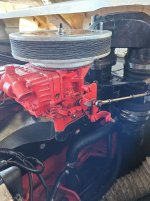
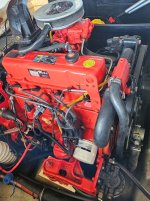
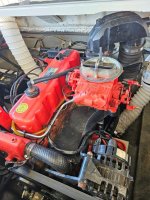
I did disconnect what I think is the fuel line into the carburetor and can't notice any fuel being pumped either while manually priming or attempting ignition. I am referring to the silver metallic pipe entering the carburetor on the left side of the image (flame arrestor removed only for these tests)
How can I check alternator in a no-start situation, or how can I check the fuel pump?
At ignition, I have a default alarm that only goes off after successful ignition, so can't really listen to the fuel pump....
Thank you for any suggestions.
 

Attachments

  • 20260408_14033211.jpg
    20260408_14033211.jpg
    352.7 KB · Views: 6

Grub54891

Admiral
Joined
Jun 17, 2012
Messages
6,428
Sounds lik your alternator is bad, but I would be removing and cleaning all battery connections completely, in clouding the grounds on the block. Get a hand held test meter, charge the battery fully, test battery before starting, then test after startup, you should get 13-14 volts from the charging system.
Anything less than 12 volts will cause sudden shut down as you describe.
 

alldodge

Moderator
Staff member
Joined
Mar 8, 2009
Messages
43,879
@kwanza1 noticed in your first post you mentioned that you were unable to get into your original account. Guessing it was @Kwanza so maybe @tpenfield can assist

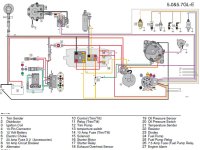
I don't have a wiring diagram for your exact model but do have one for GL-E which also uses the EST ignition. With the ALT not working this can mean power is not being supplied to the fuel pump when running (green wire and Diode).

No fuel being seen when cranking can mean power is not being supplied on the Yellow/Red wire, the other diode (23) has opened up, fuse (26 - 7.5 amp) blew, the relay (25) or fuel pump is defective.

Check voltages and fuse

VP wiring GL_E.jpg
 

Lou C

Supreme Mariner
Joined
Nov 10, 2002
Messages
13,965
Agree with starting with making sure all the wiring is clean, not corroded at terminals,etc. If you have wing nuts retaining your battery cable terminals, get rid of them, they loosen and cause these problems, use locking nuts instead.
Don't forget the large cannon plug, these can get loose and cause problems like that. One time I had a no-crank, no gauges issue but my tilt n trim worked. Cause? an oxidized old school glass fuse in the main fuse box, cause was just oxidation impeding current flow. So, it doesn't take much.
I'd start by pulling out the ignition switch and checking for battery voltage between these terminals and ground:
B terminal (battery, red wire) you should have battery volts with the battery switch on
I terminal (ignition, purple wire) you should have battery volts with the battery switch on and the key turned to the first notch after off
S terminal (start, red/yellow wire) you should have battery volts when the key is turned to start.
some ignition switches have an ACC (accessory) position, but most older boats do not.
If this reveals a loss of voltage, you have to go back and find the source.
With battery cables they can rot under the insulation and cause high resistance, make sure the (negative) return path (we call it grounds, but it is really a return path for DC current) is as good as the positive side. Automotive non-tinned cables are junk in a boat, if that's what you have ditch those and start with new. On my boat I bolted marine quality automotive style clamps onto the cable ends, that way when they start to get too oxidized I can just bolt on new ones.
 

MarineSp

Recruit
Joined
Apr 5, 2026
Messages
5
Alldodge's wiring diagram is spot on — on the GLP-D the fuel pump is electric and gets its power routed through the alternator circuit via that diode. So yes, a dead alternator can absolutely kill your fuel pump even if the battery is fully charged. Its a wierd design choice but thats how Volvo wired these.

The sudden shutoff you described (not slowly dying but a quick cut) is classic fuel starvation, not electrical. If it was ignition related you'd usually get sputtering or misfiring first. The fact that you have spark but no fuel when cranking points exactly where everyone is looking — fuel pump circuit.

One thing I haven't seen mentioned yet — the GLP-D uses a mechanical fuel pump driven off the camshaft, BUT it also has an electric fuel pump assist on some years. If yours has both, the electric one is the likely culprit since it ties into that alternator circuit. Worth checking if you have one or two pumps. The mechanical pump alone should be enough to get it running at idle even if the electric one is dead, so if your getting absolutly nothing at the carb inlet theres something else going on upstream — maybe a collapsed fuel line or a stuck anti-siphon valve at the tank.

The 3.0 GLP-D is a 181 ci inline-4 with 9.6:1 compression by the way. If compression is good and you sort out the fuel delivery this engine should have plenty of life left in it.
 

kwanza1

Cadet
Joined
Apr 7, 2026
Messages
8
Alldodge's wiring diagram is spot on — on the GLP-D the fuel pump is electric and gets its power routed through the alternator circuit via that diode. So yes, a dead alternator can absolutely kill your fuel pump even if the battery is fully charged. Its a wierd design choice but thats how Volvo wired these.

The sudden shutoff you described (not slowly dying but a quick cut) is classic fuel starvation, not electrical. If it was ignition related you'd usually get sputtering or misfiring first. The fact that you have spark but no fuel when cranking points exactly where everyone is looking — fuel pump circuit.

One thing I haven't seen mentioned yet — the GLP-D uses a mechanical fuel pump driven off the camshaft, BUT it also has an electric fuel pump assist on some years. If yours has both, the electric one is the likely culprit since it ties into that alternator circuit. Worth checking if you have one or two pumps. The mechanical pump alone should be enough to get it running at idle even if the electric one is dead, so if your getting absolutly nothing at the carb inlet theres something else going on upstream — maybe a collapsed fuel line or a stuck anti-siphon valve at the tank.

The 3.0 GLP-D is a 181 ci inline-4 with 9.6:1 compression by the way. If compression is good and you sort out the fuel delivery this engine should have plenty of life left in it.
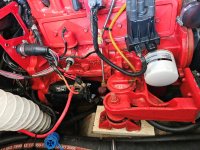
Thank you for the useful info. Whether I have a mechanical pump or not, not sure, I can only see a single fuel line coming from what I suppose is the electric fuel pump. Unless the mechanical pump is the one I use to "prime" the cold engine. Could not see any fuel coming through the disconnected inox pipe neither with a crank or a manual priming. Therefore, it is possible I have some fuel line issues further down. I attach some images of what I think the fuel pump and the fuel line are. I looked for fuel being supplied to the carburetor through the inox pipe entering the engine side of the carburetor, and also through the yellow rubber tube entering the back of the alternator.


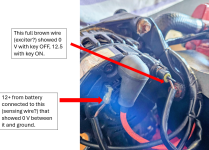
While keeping in mind that my voltmeter only indicated 12 V with the engine running. I also measured the voltage between ground and each of the two brown wires connected to the back of the alternator, and there seems to be a problem here:
Brown wire (engine side): 0.03 V with key OFF, 12.5 V with key ON. This seems correct.
Brown wire with white stripe: 0 V with key both ON and OFF. Apparently this should always read 12 V.

All fuses are good. Also swapped the "ignition relay" with a different one, no change.

Thank you.
 

Attachments

  • 1000017298aaa.jpg
    1000017298aaa.jpg
    625.5 KB · Views: 3
  • 1000017304aaa.jpg
    1000017304aaa.jpg
    918.6 KB · Views: 3
  • 1000017299aaa.jpg
    1000017299aaa.jpg
    1.1 MB · Views: 3

kwanza1

Cadet
Joined
Apr 7, 2026
Messages
8
Sounds lik your alternator is bad, but I would be removing and cleaning all battery connections completely, in clouding the grounds on the block. Get a hand held test meter, charge the battery fully, test battery before starting, then test after startup, you should get 13-14 volts from the charging system.
Anything less than 12 volts will cause sudden shut down as you describe.
Thank you, hopefully we will up and running, and back to 14 V on the gauge!
 

kwanza1

Cadet
Joined
Apr 7, 2026
Messages
8
@kwanza1 noticed in your first post you mentioned that you were unable to get into your original account. Guessing it was @Kwanza so maybe @tpenfield can assist

I don't have a wiring diagram for your exact model but do have one for GL-E which also uses the EST ignition. With the ALT not working this can mean power is not being supplied to the fuel pump when running (green wire and Diode).

No fuel being seen when cranking can mean power is not being supplied on the Yellow/Red wire, the other diode (23) has opened up, fuse (26 - 7.5 amp) blew, the relay (25) or fuel pump is defective.

Check voltages and fuse

View attachment 415529
Thank you, will work through this!
 

kwanza1

Cadet
Joined
Apr 7, 2026
Messages
8
Agree with starting with making sure all the wiring is clean, not corroded at terminals,etc. If you have wing nuts retaining your battery cable terminals, get rid of them, they loosen and cause these problems, use locking nuts instead.
Don't forget the large cannon plug, these can get loose and cause problems like that. One time I had a no-crank, no gauges issue but my tilt n trim worked. Cause? an oxidized old school glass fuse in the main fuse box, cause was just oxidation impeding current flow. So, it doesn't take much.
I'd start by pulling out the ignition switch and checking for battery voltage between these terminals and ground:
B terminal (battery, red wire) you should have battery volts with the battery switch on
I terminal (ignition, purple wire) you should have battery volts with the battery switch on and the key turned to the first notch after off
S terminal (start, red/yellow wire) you should have battery volts when the key is turned to start.
some ignition switches have an ACC (accessory) position, but most older boats do not.
If this reveals a loss of voltage, you have to go back and find the source.
With battery cables they can rot under the insulation and cause high resistance, make sure the (negative) return path (we call it grounds, but it is really a return path for DC current) is as good as the positive side. Automotive non-tinned cables are junk in a boat, if that's what you have ditch those and start with new. On my boat I bolted marine quality automotive style clamps onto the cable ends, that way when they start to get too oxidized I can just bolt on new ones.
Thank you, will work through these steps!
 

kwanza1

Cadet
Joined
Apr 7, 2026
Messages
8
Update:
connected a fused line from battery plus terminal to the sensing port of the alternator (which shows 0 V, and it should show 12 V), started smoothly, and both dash voltmeter and multi-meter show 14 V.

Am I too irresponsible going out to a sea trial? Good weather, member of marine rescue....
 

alldodge

Moderator
Staff member
Joined
Mar 8, 2009
Messages
43,879
Your motor does not have a mechanical fuel pump

connected a fused line from battery plus terminal to the sensing port of the alternator (which shows 0 V, and it should show 12 V), started smoothly, and both dash voltmeter and multi-meter show 14 V.
You have a break in a connection, don't know if that is inside the ALT or a wire. What your doing is back feeding the circuit

The relay wasn't working until it was back feed
Remember you have 2 diodes feeding the fuel pump relay, find them and use meter on diode scale to check them

Am I too irresponsible going out to a sea trial? Good weather, member of marine rescue....
You know the motor is running so taking it for a sea trial is only going to verify the failure has been bypassed, not fixed
 

kwanza1

Cadet
Joined
Apr 7, 2026
Messages
8
Your motor does not have a mechanical fuel pump


You have a break in a connection, don't know if that is inside the ALT or a wire. What your doing is back feeding the circuit

The relay wasn't working until it was back feed
Remember you have 2 diodes feeding the fuel pump relay, find them and use meter on diode scale to check them


You know the motor is running so taking it for a sea trial is only going to verify the failure has been bypassed, not fixed
Thank you.
I have to correct my earlier update. The fused line from Battery+ was not connected to the alternator terminal where the sensing cable connects, but to the sensing cable (brown with white stripe) itself.
I am now confused as to how did my engine start and why does my dash voltmeter shows 14 V (charging battery)? That is, the alternator terminal where this sensing wire connects has nothing connected to it now, and the cable itself receives the 12+ through a fused wire from the battery. Wouldn't I need the 12V on the alternator terminal itself to signal that the 12V is present, go ahead and charge?
Apologies if I don't make sense.

I ran the engine on garden hose for 10-15 minutes, with no other noticeable issues on the dash or under the engine cover.
 

Attachments

  • Screenshot 2026-04-09 221614.png
    Screenshot 2026-04-09 221614.png
    781.9 KB · Views: 5

alldodge

Moderator
Staff member
Joined
Mar 8, 2009
Messages
43,879
The left side (12V from Bat) wire is what should go to the choke coil on carb

Peal the insulation tubing back from wire on the right to find the other wire that should be connected to the other
 

MarineSp

Recruit
Joined
Apr 5, 2026
Messages
5
Good news is the alternator itself is fine since it charges at 14V once backfed. Alldodge is right about peeling back that insulation — on these Volvo harnesses the wires splice inside heat shrink or loom tape and those splices corrode over time.
I'd bet theres a corroded splice or broken solder joint under there. The brown/white wire feeds both the alternator sense and the fuel pump relay through those diodes, so one bad connection took out both systems at once. Explains everthing.

When you find it, solder it properly and use marine grade heat shrink with adhesive lining. Dont use crimp connectors in the engine compartment, they just corrode again.

And dont leave that bypass wire as a permanant fix — it works but it skips the diode protection and you could backfeed 12V into places you dont want it.
 
Top