Question regarding wiring up a carter electric fuel pump

findinghomer

Petty Officer 1st Class
Joined
Nov 7, 2009
Messages
378
OK, let me ask a dumber question. If his motor does not have the machining for a mechanical fuel pump, why does it not have the wiring for an electric fuel pump?

Bc I had to repower, and I upgraded to a vortec engine, And unfortunately it's not machined for a mechanical fuel pump
 

findinghomer

Petty Officer 1st Class
Joined
Nov 7, 2009
Messages
378
It may help understand how to wire the fuel pump if you understand why it's wired the way it is.

The fuel pump should receive power only under 2 conditions.

1. When the engine is actively cranking over, but has not yet started. In this condition, the fuel pump gets power from the bypass terminal on the starter solenoid.

2. When the engine has sufficient oil pressure to close the oil pressure switch. Under this condition, when there is no oil pressure, the oil pressure switch is open, and not sending power to the pump. When there is sufficient oil pressure, the switch closes and sends power to the fuel pump.

And that's it, under no other condition should the fuel pump be receiving power.

Yes I understand that, I was confused about how the starter doesn't get 12v back feed from the purple wire, When I'm done turning the key, and it's now in the run position.
 

Chris1956

Supreme Mariner
Joined
Mar 25, 2004
Messages
29,100
Gee, a lot of folks likely do the upgrade like you. Can you get a new wiring harness for your motor with the electric fuel pump wiring?
 

Scott Danforth

Grumpy Vintage Moderator still playing with boats
Staff member
Joined
Jul 23, 2011
Messages
53,019
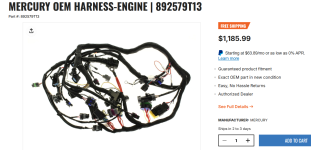
wiring harnesses are a few hundred dollars to a few thousand. the wiring needed to add a relay and oil pressure switch and the fuel pump is under $100

while you can buy a harness.....why

1787600436342.png
 

findinghomer

Petty Officer 1st Class
Joined
Nov 7, 2009
Messages
378
Gee, a lot of folks likely do the upgrade like you. Can you get a new wiring harness for your motor with the electric fuel pump wiring?
Yeah it's really not that big of a deal, But before I proceeded I just wanted to run it by the iboats experts. I just didn't see how it doesn't back feed to the starter, but somebody also gave me a tip to put a diode on that line.
 

findinghomer

Petty Officer 1st Class
Joined
Nov 7, 2009
Messages
378
Your 2 pole switch will work if you wire 86 to the starter (or yel/red) and 1 side of the OP switch. Other side of the switch goes to purple. 30 gets 12v, and 87 goes to fuel pump.
Hey Mike, when you say go to the starter, You mean that extra terminal on the starter right? The small one? Also can grab the purple wire , in the back of the engine where it goes to the coil for my ignition?
 

JustJason

Vice Admiral
Joined
Aug 27, 2007
Messages
5,380
Yes I understand that, I was confused about how the starter doesn't get 12v back feed from the purple wire, When I'm done turning the key, and it's now in the run position.
Technically it does, but only after the engine has started, not before the engine has started. But the power is on the bypass terminal which isn't connected to anything inside the starter when the key is in the RUN position after the engine has started. If anything, that bypass terminal can be thought of as an extension of the purple/yellow wire, but not actually connected to anything internally inside the starter when the key is in the run position. The terminal itself is energized but not actually sending power to anything.

An easy way to think about it is like this:
There are 3 terminals on the starter.
1. Main power lug, where the battery cable connects.
2. S terminal, the start terminal, this is where the yellow/red from the key switch connects.
3. R terminal (i think, been a while) which is the bypass terminal.

When the key is off, and battery switch is on, the main power lug always has power, but it's not connected to anything inside the starter.

When you turn the key to RUN, you send power down the purple wire to 1 side of the oil pressure switch. That is where the power stops.

When you turn the key to start, the key switch keeps applying power to the purple wire, but it now also applies power to the yellow/red wire, which activates the starter solenoid. (There is technically a slave solenoid that is also part of this equation, but I am going to skip it to keep this simple)

When the starter solenoid is activated, 2 things happen:
1. Power from the main lug is sent to the motors armature, which makes the starter turn.
2. Power from the main lug is sent to the R terminal, which is then sent to the fuel pump, bypassing the oil pressure switch.

After the engine starts and you let go of the key, it defaults back to the run position. This means power on the purple wire only. As such the circuit inside of the starter solenoid is no longer active, and power on the main lug is no longer being sent to the R terminal.

Because the engine now has oil pressure, the power that originally stopped at the oil pressure switch now flows through the oil pressure switch because the switch closes with oil pressure. This power goes to the fuel pump, but, as it's also connected to that same purple/yellow wire that goes to the starter's R terminal, power is in fact backfed to the starter solenoid. But, because there is nothing inside the solenoid that is connected to anything when the key is not in the start position, nothing happens and no problems are created.
 

findinghomer

Petty Officer 1st Class
Joined
Nov 7, 2009
Messages
378
Technically it does, but only after the engine has started, not before the engine has started. But the power is on the bypass terminal which isn't connected to anything inside the starter when the key is in the RUN position after the engine has started. If anything, that bypass terminal can be thought of as an extension of the purple/yellow wire, but not actually connected to anything internally inside the starter when the key is in the run position. The terminal itself is energized but not actually sending power to anything.

An easy way to think about it is like this:
There are 3 terminals on the starter.
1. Main power lug, where the battery cable connects.
2. S terminal, the start terminal, this is where the yellow/red from the key switch connects.
3. R terminal (i think, been a while) which is the bypass terminal.

When the key is off, and battery switch is on, the main power lug always has power, but it's not connected to anything inside the starter.

When you turn the key to RUN, you send power down the purple wire to 1 side of the oil pressure switch. That is where the power stops.

When you turn the key to start, the key switch keeps applying power to the purple wire, but it now also applies power to the yellow/red wire, which activates the starter solenoid. (There is technically a slave solenoid that is also part of this equation, but I am going to skip it to keep this simple)

When the starter solenoid is activated, 2 things happen:
1. Power from the main lug is sent to the motors armature, which makes the starter turn.
2. Power from the main lug is sent to the R terminal, which is then sent to the fuel pump, bypassing the oil pressure switch.

After the engine starts and you let go of the key, it defaults back to the run position. This means power on the purple wire only. As such the circuit inside of the starter solenoid is no longer active, and power on the main lug is no longer being sent to the R terminal.

Because the engine now has oil pressure, the power that originally stopped at the oil pressure switch now flows through the oil pressure switch because the switch closes with oil pressure. This power goes to the fuel pump, but, as it's also connected to that same purple/yellow wire that goes to the starter's R terminal, power is in fact backfed to the starter solenoid. But, because there is nothing inside the solenoid that is connected to anything when the key is not in the start position, nothing happens and no problems are created.
That's a great , thorough explanation, thank you! I totally get now , thanks to all you guys šŸ¤˜šŸ¼
 
Top