Transom repair, new plywood from above?

larstore

Cadet
Joined
Sep 12, 2016
Messages
15
If a transom is really not accessible from inside, would it be a solution to remove all the wet/rooten wood from the top (chainsaw or similar methods used with "purable" products), soak a new sheet of matched plywood in epoxy/polyester and insert it from the top?

Lars
 

tpenfield

Moderator
Staff member
Joined
Jul 18, 2011
Messages
18,846
Possibly, but posting a few pictures would be good for responses and guidance.
 

larstore

Cadet
Joined
Sep 12, 2016
Messages
15
Here we go. This is just a shot of my transom. Based on what i can see from the inside, there is no wood behind the "extended flares" on the top sides. So, either the wood is just in the center piece under the engine, or extended on the sides. However, because of the different angle between the center and the sides, i am guessing not, or atleast separate pieces.

The idea is too cut the top of the splashwell, and possible insert new pre-cut plywood. If not, i am planning to use a liquid "pourable" transom.

What do you think? Will inserting a new plywood from the top and possibly filling the cavities with with polyester resin be a possible solution?
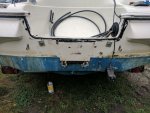
IMG_20170924_090541.jpg
 

eggs712

Petty Officer 1st Class
Joined
May 8, 2012
Messages
361
I've done it, but I wound up having to cut some of the exterior skin to properly measure the new wood and get it back in there. You also have to be able to glass the new wood from the inside. Some people get around this by using a pourable transom like Seacast, but it's very expensive.
 

larstore

Cadet
Joined
Sep 12, 2016
Messages
15
You also have to be able to glass the new wood from the inside..

Thats my main question. If using the same plywood tickness as before, one would probably need to hammer it down into the transom.. thats why i wanted to soak it in polyester first..
 

eggs712

Petty Officer 1st Class
Joined
May 8, 2012
Messages
361
Resin without glass will delaminate. The glass holds the resin (think of it as glue) together and gives it strength. You also have to bond the new wood to the transom skin.

There are a lot of great threads here to read and learn from. The experts here have decades of experience, much of it from actually being in the industry. I'm sure one or more will come along and help you put together a game plan 👍
 

larstore

Cadet
Joined
Sep 12, 2016
Messages
15
You also have to bond the new wood to the transom skin

I am probably missing something here, but after removing all the old wood, i would think the old fiberglass surface would bond to the new plywood, which would be soaked in resin just before putting it into the transom?
 

eggs712

Petty Officer 1st Class
Joined
May 8, 2012
Messages
361
To bond new glass to old glass, the surface must be ground/sanded to fresh glass, then wiped with acetone to make it tacky again. It's just really hard to do down deep in your transom with a small gap to reach down.
 

larstore

Cadet
Joined
Sep 12, 2016
Messages
15
...wiped with acetone to make it tacky again. It's just really hard to do down deep in your transom with a small gap to reach down.

I would think that is the case for products like seacast also? That is the alternative. Just curious if anyone tried just using plywood for this. If the transom is easy to reach from above, it seems like a pretty simple solution
 
Top