Mercruiser 4.5l low vacuum, WOT 4350 and higher fuel consumption

damo79

Seaman
Joined
Jul 27, 2025
Messages
59
NO.
I keep saying these MAP readings are normal.
While I don't have any other 4.5 Diacom REC files to compare (I have always used Mercs G3 on these engines because I'm at a dealer and I now work the parts counter and no longer have access to G3) but, I do have a bunch of Diacom REC files for similar engines. When I look at ANY of those files All of them have MAP readings at idle that are the same or lower. This engine has an Electronic Throttle Body O2 sensors and Adaptive Speed Control (ASC) it isn't the same (or really even comparable) to a carb, Throttle Body injection or even a MPI 555 engine. I don't know where you're getting this 17-22 number from, but it's not from Merc or someone who is familiar with these latest generation engines.

I've had a chance to review the 2 newest REC files you posted. Not a lot of diagnostic data in them because of how you were operating the throttle.
Maybe I should have been clearer about how to make a REC file.

"Run around until engine reaches complete warm up."
This will take 15-30 minutes depending on a few things, sea water temp, cooling poppet spring tension, hull weight/design, etc.
This will answer your oil pressure question - it wasn't fully up to temp, so it will read a little high. But those oil pressure readings you're seeing are normal. You also asked about the sea water temp reading - you don't have that sensor, so 32° is there because it's the default number Merc programmed in the PCM.

"Now back to idle and then increase RPMs in 500 RPM increments holding steady at each for 5 minutes."
This should take about one hour, you can shave the 5 mins to 3 mins if you don't have the time. The 2 REC files you posted are only about 15 mins total, so like I said -- not much usable data. If you're wondering what I'm talking about, just graph "O2 Control State" and "RPM / Load State" do you see how they're jumping all over the place? Nobody can get solid diagnostic numbers when this is happening.

But I am able to some things wrong.

Sea Water pressure, impeller, sensor, wiring or something else in the cooling system. This needs to be addressed, The PCM112 monitors this number and adjusts different things due to the low numbers. So it will affect what different tables like spark, fuel, VE (volumetric), ER (equivalency ratio) the PCM uses.

Trim sender is jumping all over. It even told the PCM you were in trailer mode a couple of times. I'm not sure how much of this the PCM looks at or adjusts tables because of, or even what the countdown timer is for this data point. So I can't say for sure if you need to replace the sender/troubleshoot the wiring like I can for the sea water pressure and the biggest thing I saw in the files, up next.

You have a bad battery and/or wiring issues. The PCM is seeing about 8.5 volts on the Battery volts and just a little higher on System volts. This is REALLY bad and will cause all sorts of weird issues. I haven't seen MerCruiser post a number for the PCM, but 10.5v was considered bad with the 555 and Mercury does post a number for the outboards with the PCM112 and that is 11.5 v. So your boat is way low.

I'll take look at some of your other questions and see if I can answer them.
17-21"Hg probably some general info found online - sorry my bad. But there is page in service manual for this engine that specifies that. See attached. Only difference that it states normal as 15-21Hg. Did you see my fuel supply module checks? Fuel pressure is not in the proper range either not because it's faulty but it's controlled by vacuum and this is off. Can we now agree or still not? I understand that you've seen less on other engines but was that correct?

When its comes do recording. Tried my best. 1st recording 15min. Warm up complete after 9min. Then 1min at 3000 O2 in closed loop all the time then idle nearly 2min then 3000rpm 1min O2 closed loop that time then 4000rpm stopped by alarm. Second file is 11min. At idle 2min then acceleration to WOT thats maybe to short but was warried about water pressure. Then again idle and again 3000rpm almost 2min, idle and trolling to marina. Every time after setting rpm and planning at 3000 o2 state stayed in closed loop and engine load steady. Only time it changes to open when boat accelerates but thats normal that PCM goes to open loop. 1-2min at the same speed or 3-5min will it make a difference? Anyway will try again and time you spent on that and replying to my posts is much appreciated.

I will definitely adress cooling system and trim sender wiring.

Where did you see that 8.5volts? I checked both recordings and battery volts, system volts stays 14+V and sensor power 5V.
 

Attachments

  • IMG-20260806-WA0001.jpg
    IMG-20260806-WA0001.jpg
    125.2 KB · Views: 5

damo79

Seaman
Joined
Jul 27, 2025
Messages
59
Didn't know you were on the other side of the pond!
I have NO idea how this might affect anything.
The only thing I know about prepping a boat for Europe is from many years ago having to install a special transformer for shore power on a boat heading there. That was back in the Days of MEFI so you might want to call Merc if there is anything about the PCM 112.
CONSUMER SUPPORT for North America is,
Mercury Outboards / MerCruiser / MotorGuide
Phone: 920-929-5040
Maybe they can advise?
Thought you noticed that I don't write like native.
The only time theboat is connected to power here is to charge battery and regardless if its US or Europe it will always get proper DC supply from battery charger.
 

damo79

Seaman
Joined
Jul 27, 2025
Messages
59
I really don't think you have a problem with lifters or cam timing. Your fuel trims look too good. But if I had some good O2 numbers I could be more sure.

Also with the electrical problem you have, all bets are off on these numbers.

The PCM Diagnostic manual gives a little info on how all this works. Like I said it uses many different "tables" to adjust all this stuff. Unfortunately all these manuals are written for a Mercury trained tech. So I'm guessing it might be pretty hard for the normal person to understand. Good Techs spend a lot of time learning this stuff.
I know fuel trims and, o2 target and o2 sensor response looks perfect. But what in the situation that the timing is wrong. What if fuel burns too late when piston already moves down and some of combustion goes out through exhaust valve opening to early. Will o2 sensor notice any difference? It not then fuel trims will look perfect too.
Read that PCM112 manual briefly and its not that that I'm not trained Merury tech I think information there is just vague. They wont share much about PCM logic.
 
Last edited:

damo79

Seaman
Joined
Jul 27, 2025
Messages
59
Spark advance looks pretty good to me. But once again --- low cranking volts could affect this.
Did you mean ° degrees or % percent?
What sensor are you thinking of?

But that does bring up a somewhat exotic possibility. I've never seen it, but in class the instructor does bring up the possibility of the RELUCTOR WHEEL slipping on the crankshaft. I've never had a 4.5 apart so I'm not sure if this engine is keyed (can't slip) or pressed (can slip)
Can you tell from drawing below. I can't see key there.
 

damo79

Seaman
Joined
Jul 27, 2025
Messages
59
That doesn't explain your fuel consumption. Your vacuum looks ballpark once you get off idle. And unless you have the specs, you're just guessing that it remains off throughout the rpm range.
Unless you have the specs your ''ball park'' is guessing as well ;)
 

damo79

Seaman
Joined
Jul 27, 2025
Messages
59
They didn’t mention any problems with the keyed ones in school, good to know.
I’m guessing that at least you could poke something through the CPS hole and get it to wiggle.
Took that sensor out earlier to check for potential dirt - I guess its magnetic. I will try with screw driver but will I see any movement if it slipped? Worth to try anyway
 

nola mike

Admiral
Joined
Apr 22, 2009
Messages
6,013
Unless you have the specs your ''ball park'' is guessing as well ;)
True, but 0.6" at WOT probably isn't an issue. No turbo that you're not telling us about, right? I'm still looking at the initial screen shots, I don't know if those rec files are readable without diacom. @muc I was looking at the timing at 3k rpm (29') vs 4k/4300 (20')
 

damo79

Seaman
Joined
Jul 27, 2025
Messages
59
True, but 0.6" at WOT probably isn't an issue. No turbo that you're not telling us about, right? I'm still looking at the initial screen shots, I don't know if those rec files are readable without diacom. @muc I was looking at the timing at 3k rpm (29') vs 4k/4300 (20')
If you want you can install Diacom and check files. If free and it will work. I will appreciate another point of view.
 
  • Like
Reactions: muc

tpenfield

Moderator
Staff member
Joined
Jul 18, 2011
Messages
19,308
I still have the Diacom software, PM me if you want and I'll send you my email so you can send me a file or 2 for an additional set of eyes on your data.
 
  • Like
Reactions: muc

alldodge

Moderator
Staff member
Joined
Mar 8, 2009
Messages
44,348
Here is the LINK to download the software. It's legal to download and use, it just will not work for diagnostics on a motor without purchasing the adapter
 

damo79

Seaman
Joined
Jul 27, 2025
Messages
59
Attached file with two latest recordings. Please feel free to comment if you notice something unusual
 

Attachments

  • MERC_CAN 08 04 2026 18 27 04.zip
    120.7 KB · Views: 1

muc

"Retired" Association of Marine Technicians...
Joined
Jul 7, 2004
Messages
2,380
I haven't had much time today to spend on this, but I did want to cover the most important part ---- electrical system.

There are a lot of checks, calculations and choosing of all the tables that happen during starting, so correct power is critical. This is why I recommend that during starting. Turn the key to ON and wait a couple of seconds and then turn to START.

Open Diacom
Load the REC file with the cranking event.
Top of screen select Graph
Left side of screen click the top button
Now chose
batt volts
engine speed
system volts and click ok
Here is what I see.

system @12.5v batt @12.0v so we have a .5v drop between these 2 before cranking.
Here's where I have to Guess, Diacom doesn't always use the same names as Mercury does.
My guess, batt is probably looking at the Clean Power and system is probably looking at the internal voltage regulator in the PCM. system will be the more important of the two, because this is what the PCMs calculations is based on.

Now scroll to where the RPMs start going up, see what happens to the system and batt? system now @ 8.46v and batt at 10.06v so we now have a 1.6v drop between these two. And a WAY to low voltage!

Now scroll some more to where RPMs reach max. We now see system @ 14.7 and batt @ 14.3 = .4v

Now lets do some math and look a little deeper.
The voltage drop during cranking is system 4.04 v and batt 1.94v. This is a 2.1v difference between them during cranking.

Any drop above 0.5v is bad. So 0.4 while at full charging is the only good number you have!

This leads me to think you have a bad battery and some excessive resistance in the wiring.

Troubleshooting,
Start with physical inspection. At the battery remove all negative connections and inspect them. Note that 4 connections are all that's allowed. They should be stacked with the wire that uses the most power is closest to the battery and so on. Put tie strap thru all the rings so the wires all stay together and put them to the side.
Now the positive post, same deal but this time there will be an inline fuse in the clean power wire, pull it out and inspect it to.
Now it gets a little (or a lot - depends on the boat) harder. Follow the pos+neg big cables and clean power ALL the way to their ends. You are looking for any splices, connectors and terminations, like the battery switch.
disassemble and inspect all of them.
A good marine tech will skip this and instead do a voltage drop test on these 4 wires, but I have seen soo many junior techs screw this up, only attempt if your very confident in your electrical skills.
Now with everything reassembled and install a "known good" battery.
I HIGHLY recommend a AGM that is at LEAST 800 CCA, 1000 MCA, 190 Ah.
Retest with Diacom.

Now here is something that you can try next time your on the boat (after you have fixed the electrical problem --- I don't think I can stress this enough! We have identified a problem, this must be corrected before any more troubleshooting!).

After you have done the new complete Diacom REC files.

Check the breather hose that runs from near the flame arrester and make sure you can blow through it. Now find the PCV on the other valve cover and check that it rattles, replace with a new Mercury Marine one if you want. $17.00 here in the states and probable should have been replaced already any way. Now follow that hose to the intake manifold, remove it and plug the nipple in the manifold. Run the boat and see what happens now that you have removed the calibrated air leak and have higher vacuum in the intake.
 

muc

"Retired" Association of Marine Technicians...
Joined
Jul 7, 2004
Messages
2,380
17-21"Hg probably some general info found online - sorry my bad. But there is page in service manual for this engine that specifies that. See attached. Only difference that it states normal as 15-21Hg. Did you see my fuel supply module checks? Fuel pressure is not in the proper range either not because it's faulty but it's controlled by vacuum and this is off. Can we now agree or still not? I understand that you've seen less on other engines but was that correct?

When its comes do recording. Tried my best. 1st recording 15min. Warm up complete after 9min. Then 1min at 3000 O2 in closed loop all the time then idle nearly 2min then 3000rpm 1min O2 closed loop that time then 4000rpm stopped by alarm. Second file is 11min. At idle 2min then acceleration to WOT thats maybe to short but was warried about water pressure. Then again idle and again 3000rpm almost 2min, idle and trolling to marina. Every time after setting rpm and planning at 3000 o2 state stayed in closed loop and engine load steady. Only time it changes to open when boat accelerates but thats normal that PCM goes to open loop. 1-2min at the same speed or 3-5min will it make a difference? Anyway will try again and time you spent on that and replying to my posts is much appreciated.

I will definitely adress cooling system and trim sender wiring.

Where did you see that 8.5volts? I checked both recordings and battery volts, system volts stays 14+V and sensor power 5V.
Yes I looked at the chart --- it's the same chart that's in all the manuals since the beginning of time.
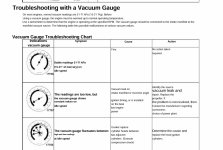
I noted that it starts with "most engines" seeing as that chart has been around since points and carbs, I would say you don't fall under that category. I also noted that under low vacuum, first is leaks and 2nd is prop.
I saw earlier that you dropped 2" in pitch with no real change, you should have picked up about 300-400 RPMs -- was that not a red flag?
When they say prop -- what they really mean is to check from one end to the other. That's engine alignment, correct gear ratio and no excess friction the the drive along with correct prop mounting. Along with this is the hull, I don't mean any offence but this is a Bayliner, not known for the strongest hulls. I've seen many boats that sit on bunks or rollers that don't reach the transom. This can cause a hook in the hull and will change propping. This is why we don't guess about correct pitch -- we test in the water.

Yes I watched the fuel pressure tests. But because I used to be a tech, all I see is that you have a gauge that you can't bleed the air out of it (like the manual wants) and it appears to be the cheapest fuel pressure gauge that money can buy. A lot of cheap gauges I've tested read wrong when I check them against a good gauge and it's common that they don't just read a few psi off consistently across the range. I find many that read low at one end of the dial and high at the other end. But when I look at the REC files I don't see the issues I normally expect with low or high pressure, so I gave that a pass. But like I pointed out earlier --- you have an electrical issue that could be critical and the REC files have never had enough good info to be sure. Have you serviced the fuel filter and checked for water? Have you used a temporary fuel tank with good fuel to isolate the boat from the motor. Both are standard troubleshooting and are a really good idea.

Still don't think the vacuum is the ROOT CAUSE. But I'm setting in a comfy chair and I'm not seeing, hearing and feeling what you are, and sometimes that can really matter.

Use the graph function in Diacom to look at O2 control state and RPM / Load state. Are you seeing what I'm seeing? in-out / up-down

Yes I can understand the trials and tribulations of trying to get a good recording. I've had to tow the customer and his wife on a tube with a drift sock at the same time to load the engine and duplicate his complaint. It was a small lake. Yours is a little tougher because of the ASC that's programed in the PCM. Just do the best you can. This takes a lot of time -- don't try to hurry it. garbage in garbage out

We should back up to the beginning.
So I have one more question. What is the complaint that started all this????
We techs are trained on.

Complaint
Cause
Correction

If you keep putting in effort, I will to -- when I have the time.
 

muc

"Retired" Association of Marine Technicians...
Joined
Jul 7, 2004
Messages
2,380
True, but 0.6" at WOT probably isn't an issue. No turbo that you're not telling us about, right? I'm still looking at the initial screen shots, I don't know if those rec files are readable without diacom. @muc I was looking at the timing at 3k rpm (29') vs 4k/4300 (20')
This engine never really gets stabilized enough to look in depth. The fuel and ignition tables are changing to often for me.
 

muc

"Retired" Association of Marine Technicians...
Joined
Jul 7, 2004
Messages
2,380
I checked in service manual its a keyway.
Yes there is a crank key, but does it include the reluctance wheel or is it just for the cam gear and harmonic balancer. I can't tell.
 

muc

"Retired" Association of Marine Technicians...
Joined
Jul 7, 2004
Messages
2,380
I know fuel trims and, o2 target and o2 sensor response looks perfect. But what in the situation that the timing is wrong. What if fuel burns too late when piston already moves down and some of combustion goes out through exhaust valve opening to early. Will o2 sensor notice any difference? It not then fuel trims will look perfect too.
Read that PCM112 manual briefly and its not that that I'm not trained Merury tech I think information there is just vague. They wont share much about PCM logic.
I guess that would depend on advanced or retarded. From my understanding this usually happens during a extreme event. Like a hard under water strike or wake jumping. But lets fix the easy stuff before looking at the odd ball stuff.

Yes the manuals can have some issues. Note that Mercury doesn't want us to use the paper manuals anymore. They are out of date the moment they come off the press. The Diag manual for your PCM has been updated 3 times since the first printing to correct errors and update info. And because the last revision was in 2022, it's probably due for anouther. Mercury wants us to download a updated manual anytime we work on a product.

The manual just contains a little theory to jog the memory of a trained tech.

Mercury really tries to force consumers to bring the boat to a dealer that has G3 and a trained tech. G3 will walk the tech through most troubleshooting.
Case in point, the warning horn you had. Most faults have at least 2 things that have to happen before setting a code. In the case of the sea water pressure. The engine must now reach a certain RPM before a horn and that low pressure must last a certain amount of time. Mercury doesn't put that in the manual, you only hear about it in school. And did you see how I said now on the RPM, it wasn't like that in the early days. They changed the program after getting too many nuisance horns. That's another reason they want the engine connected to G3, whenever we connect, G3 checks for the latest program and won't let us go any further until we update it.

Yes there could be many causes for your problem, maybe more then one. That's why we test and identify a problem, correct it and retest.

electrical issue
low sea water pressure
and maybe trim sender

This is why I keep pushing you to focus on the basics. Who knows? Maybe you got a miss stamped prop and it's really 20 1/2" pitch and you really just need to correct the issues we have found and put on a good 19" or maybe 17" prop to get this right.

Your focused on vacuum and as near as I can tell you don't know what gear ratio is on this boat. Or even are sure what the prop pitch is, if you have a prop shop near you, they will throw throw the prop on pitch blocks and confirm it --- for free. Any good tech would have ruled out all this stuff I've talked about before even caring what the MAP is.
 
Top