Questions about the set up of a Holley 4160 on a 4.3 V6

Lou C

Supreme Mariner
Joined
Nov 10, 2002
Messages
14,278
Ok guys, my Quadrajet acted up again over the past 2 seasons, not running right, I had it all apart, tried to clean it the best I could, but no joy. So I took the Holley out of the garage that I tried a few years ago, the first time I tried it it wouldn't run right (loading up, too rich) so after re-doing the Quadrajet I took it apart, found a few things that didn't look right (loose clutch bolts on the rear metering plate) but never tried it again till now.
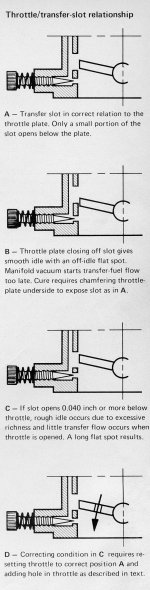
So I bolted it up, it runs surprisingly well, the primary mixture screws respond to adjustment as they should, but I can't get it to idle slower than about 670-700 rpm which I think is a bit too high for a dog clutch outdrive. I am wondering if maybe the secondary throttle adjustment screw (that little screw you can only see with the carb off) might need to be adjusted, but from what I can see from looking in the secondary barrels, the secondary throttle plate seems fully closed, I can see there is a small port below them and the transfer slot above them.
Any suggestions from the Holley guys (Scott?) I'd like to get it down to 600 rpm if possible.
You'll all laugh but I also have a brand new Edelbrock 1409 in case this doesn't work out as planned! But it is more work to install, I have to figure out the throttle linkage and I have to fab a bracket to move the big shifter bell crank mount that OMC used on the Cobras up and over about 1.5" for the wider Edelbrock with the side mounted fuel line to fit.
The Holley while some feel it can be more troublesome, is an easier conversion because OMC and Volvo started using this exact carb in 1990 after they quit building Quadrajets.
I have all the OEM parts to make it work (throttle cable mount, adapter, metal fuel line, etc).
Thoughts?
 

Lou C

Supreme Mariner
Joined
Nov 10, 2002
Messages
14,278
Won’t fit on a 4.3 the front fuel line will hit the thermostat housing. The 4.3 used the side mount fuel inlet.
 

Scott Danforth

Grumpy Vintage Moderator still playing with boats
Staff member
Joined
Jul 23, 2011
Messages
53,053
Flip the carb over. The secondary screw is underneath.

Make sure the transfer slots are both square on the revealed part
 

Scott Danforth

Grumpy Vintage Moderator still playing with boats
Staff member
Joined
Jul 23, 2011
Messages
53,053
Once you get the slots squared up. You will need a vacuum gauge to set mix. Should be about 3/4-7/8 turn out
 

Lou C

Supreme Mariner
Joined
Nov 10, 2002
Messages
14,278
The carb & manifold don’t have any vacuum ports so I have to use my dwell tachometer. I know about making the primary transfer slot square but the secondary is different because those slots are higher up. So should the secondary throttle plate be totally closed to get the idle lower, or opened the same amount as the primary? I recall reading this before….
 

jimmbo

Supreme Mariner
Joined
May 24, 2004
Messages
14,631
The carb & manifold don’t have any vacuum ports so I have to use my dwell tachometer. I know about making the primary transfer slot square but the secondary is different because those slots are higher up. So should the secondary throttle plate be totally closed to get the idle lower, or opened the same amount as the primary? I recall reading this before….
When the Primary plates are in the correct location relative to the Transfer Slots, the Secondary Plate can be adjusted to attain the correct Idle Speed, a real PIA.
As for a Vacuum source. Does the Carb have a Choke Pulloff? If so, once the Choke is fully open, it doesn't rely on it, and it's source of Vacuum can be used

8062036-Throttleposition067.jpg
 

Scott Danforth

Grumpy Vintage Moderator still playing with boats
Staff member
Joined
Jul 23, 2011
Messages
53,053
The carb & manifold don’t have any vacuum ports so I have to use my dwell tachometer. I know about making the primary transfer slot square but the secondary is different because those slots are higher up. So should the secondary throttle plate be totally closed to get the idle lower, or opened the same amount as the primary? I recall reading this before….
Get the primary transfer slot set square.
Since your 4160 secondary slots are up high, this is just a 2-screw idle mix carb. Get the secondaries just to they kiss fully closed

Use an unlit propane torch to set idle mix. You will just be waving the torch over the carb. If you add a bit of propane to the carb throat and idle increases, back out the screws 1/8 turn. If you add a bit of propane and the idle mix drops over 30 rpm, turn the screws in just a bit.

If you wave the propane over the throat and RPMs do not change much, you are as close as you can get without a vac gauge

Then adjust idle speed
 

Lou C

Supreme Mariner
Joined
Nov 10, 2002
Messages
14,278
Yes it’s a pita but I guess that’s one difference between Holley & the QJet. So I’ll just keep at it till it’s right.
This carb doesn’t have a vacuum pull off it uses the old style vacuum piston inside the choke housing.
 

jimmbo

Supreme Mariner
Joined
May 24, 2004
Messages
14,631
Both Carbs have their adjustability Issues. In the case of Holleys, they do sell a lot of Parts to make a lot of Recalibrations a bit easier.
With Q-Jets, a very large collection of scrap Carbs can yield some of the Parts
 

Lou C

Supreme Mariner
Joined
Nov 10, 2002
Messages
14,278
Going to hook up the throttle linkage (I have the correct bracket for the OMC throttle bracket which is different from the one used on Rochester carbs) and also the electric choke later today after I complete my honey do list lol. Which brings me to a question:
Of course, the + lead for the choke from the alternator should be fused (even though it's not in some OEM OMC and Volvo applications) but the first time I tried to use this carb I also used a relay, does a Holley electric choke draw enough current to actually need one? I did it that way because I called tech support at ARCO (I have an ARCO alternator) and the guy I spoke to thought it was a good idea. I will do it that way if that's the best set up.
I have to go back and figure out which terminal on the alternator puts out current only when the engine is running, so that the choke doesn't come off too fast.
The old divorced (well type) choke on the Rochester always took a long time to open up because marine engines run cooler than the auto applications that these were based on, so it will be nice to have a faster opening choke.

Thoughts?
 

Bondo

Moderator
Staff member
Joined
Apr 17, 2002
Messages
71,512
The old divorced (well type) choke on the Rochester always took a long time to open up because marine engines run cooler than the auto applications that these were based on, so it will be nice to have a faster opening choke.

Thoughts?
Ayuh,.... I believe that's unnecessary,......
I've run both types, with no differences, at all,....
 

Lou C

Supreme Mariner
Joined
Nov 10, 2002
Messages
14,278
Did you mean running the auto electric choke off of a relay is unnecessary? I’m thinking so since the wire from the alternator to the choke is pretty short. Now if it was an auto application with the power being taken from the fuse box it might make sense due to the length of the wire run.
Still confused on the relationship between how far the primary throttle plate is open vs how far open the secondary throttle plate is open.
I set the primary so the transfer slots are square as recommended and set the secondary so the adjustment screw just contacts the lever that opens the secondary. Not sure if it’s right but I guess I’ll find out.
 
Top