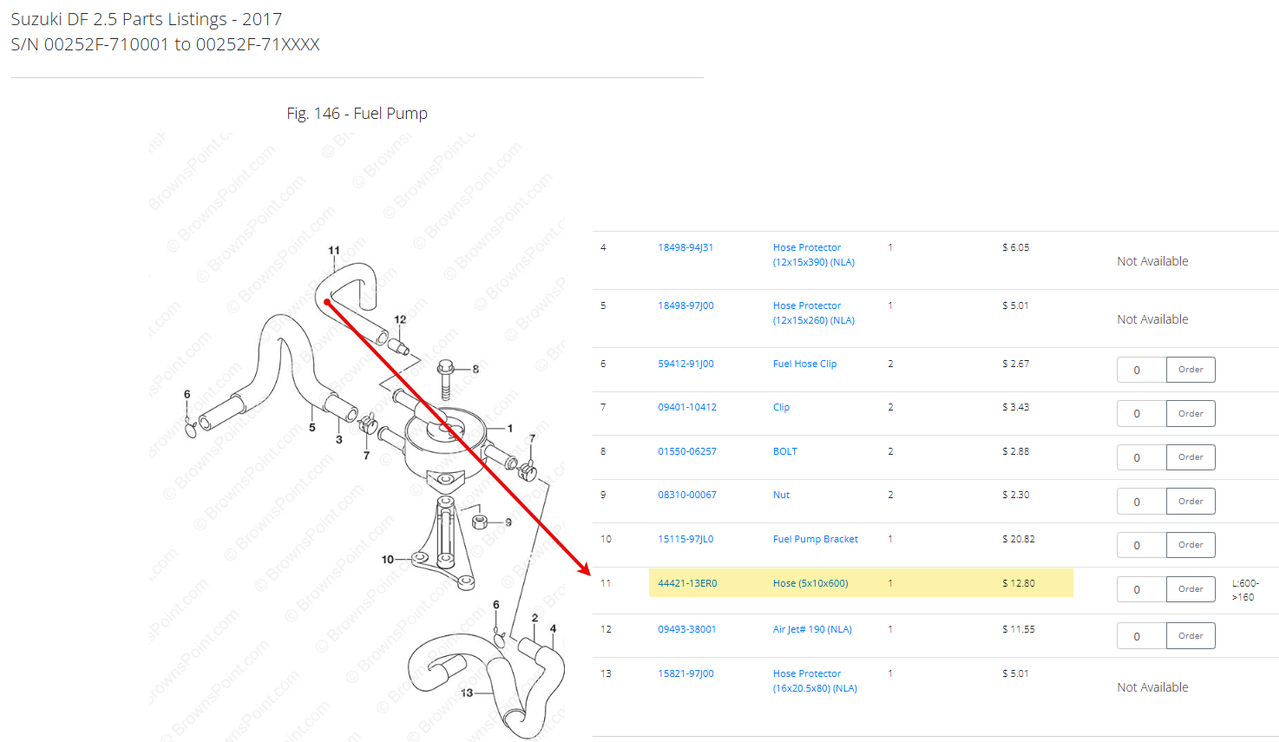
Vacuum line for Suzuki 2.5HP 4 stroke outboard

Mc Tool

Lieutenant Commander
Joined
Aug 7, 2024
Messages
1,795
Either cut the old jet out and re-use or get just about anything the right dia (like a piece cut out of a brass bolt ) and drill a hole in it about the same size . I used a roll your own cigarette butt stuffed into the hose to dampen pulses on my fuel injected Ducati ...been there for years . Or if you have money to spare go buy a fuel metering jet off something .
 

Mc Tool

Lieutenant Commander
Joined
Aug 7, 2024
Messages
1,795
If you look at the photo I included,you will see the bottom part of the lighter grey hose is attached at the back of the carb.... I'm sorry, I don't know what it's called, but that's the one that needs replacing.
What your refering to as the back of the carb is actually the intake port and thats where the pump gets its pulse from ....as the intake stroke happens there is a vacuum pulse as the piston descends sucking air in ....this vacuum sucking/ pulse is transferred along the light gray hose in question to the pump diaphragm . I think that the reason that brass orifice is there is to dampen the pulse a bit because the gray hose is quite short.....for example compared to the same hose on my quads which is over a foot long and as such is self dampening . Heaps of small and some large 4 stroke motors that have to lift fuel ( not gravity fed like a motor bike with the tank higher than the carb ) have a vacuum operated fuel pump . While Suzuki have gone to some length to make this harder than it need be any hunk of ( uscg approved 🙄)hose with some similar sized restriction will do the trick .
 

trooper1954

Petty Officer 3rd Class
Joined
Jun 29, 2018
Messages
90
What your refering to as the back of the carb is actually the intake port and thats where the pump gets its pulse from ....as the intake stroke happens there is a vacuum pulse as the piston descends sucking air in ....this vacuum sucking/ pulse is transferred along the light gray hose in question to the pump diaphragm . I think that the reason that brass orifice is there is to dampen the pulse a bit because the gray hose is quite short.....for example compared to the same hose on my quads which is over a foot long and as such is self dampening . Heaps of small and some large 4 stroke motors that have to lift fuel ( not gravity fed like a motor bike with the tank higher than the carb ) have a vacuum operated fuel pump . While Suzuki have gone to some length to make this harder than it need be any hunk of ( uscg approved 🙄)hose with some similar sized orifice as the restriction will do the trick .
Thx Mc Tool....great explanation for a non mechanic like me. So if I understand correctly, any hose with an ID the same orifice as the brass restrictor should work? Would I be able then to get that size of hose to push onto the fuel pump nipple? It seems much larger?
I think I found where I can buy an OEM replacement hose but won't know until Tuesday. Thanks again for the help.👍
 

boscoe99

Commander
Joined
Aug 22, 2013
Messages
2,339
What your refering to as the back of the carb is actually the intake port and thats where the pump gets its pulse from ....as the intake stroke happens there is a vacuum pulse as the piston descends sucking air in ....this vacuum sucking/ pulse is transferred along the light gray hose in question to the pump diaphragm . I think that the reason that brass orifice is there is to dampen the pulse a bit because the gray hose is quite short.....for example compared to the same hose on my quads which is over a foot long and as such is self dampening . Heaps of small and some large 4 stroke motors that have to lift fuel ( not gravity fed like a motor bike with the tank higher than the carb ) have a vacuum operated fuel pump . While Suzuki have gone to some length to make this harder than it need be any hunk of ( uscg approved 🙄)hose with some similar sized restriction will do the trick .
Does not even have to be USCG approved.

Not understanding how Suzuki is making it harder than it needs to be. Replacement hose is available from Suzuki. The orifice/jet is not available but should not be needed anyway.

The Suzuki service manual may have additional details available that perhaps may be useful.

Strange to me that folks working on stuff won't/don't take the time to buy a manual. Or at least when asking for free advice ask about the theory of operation. How it works.
 

99yam40

Fleet Admiral
Joined
Sep 7, 2008
Messages
9,305
My guess is #11 is the hose and #12 is the jet inside the hose.

Pump has to have a fuel hose into pump and a fuel hose out of pump, and the pulse hose to make the pump operate
 

Mc Tool

Lieutenant Commander
Joined
Aug 7, 2024
Messages
1,795
Thx Mc Tool....great explanation for a non mechanic like me. So if I understand correctly, any hose with an ID the same orifice as the brass restrictor should work? Would I be able then to get that size of hose to push onto the fuel pump nipple? It seems much larger?
I think I found where I can buy an OEM replacement hose but won't know until Tuesday. Thanks again for the help.👍
The hose will be a standard size ...like 4 or 6mm , the orifice ...as boscoe99 says is probly not really needed but I was holding off actually saying that 😁.
If that were mine and that brass orifice was "stuck in there " I would cut the rubber hose off it ... maybe give it a wizz in the wire wheel ( thread it on to a bit of wire to hold it ) to get all the glue ,rubber whatev off it ,grease it up and shove it into the new hose . Im just thinking that without that orifice the pulse might be strong enough to be a bit hard on the pump diaphragm and cause early failure .
As for Suzuki makeing it harder than need be ...I meant that glueing it in there ,not making the thing available . Tbh I would never consider buying that as a part ,how much would it cost as opposed to 50¢ worth of hose and re-use the orifice .
AND ....a manual ,either paper copy or pdf is the best money you could spend on your motor . I have been mechanic-ing for 45 years and I get manuals for everything . Having said that some are better than others , factory manuals are best .🙂
 
Top