Help! Bought a 1993 Four Winns W/ 5.0 OMC Cobra Motor and Drive - Losing power after crusing

cameron92

Seaman Apprentice
Joined
Jun 18, 2026
Messages
31
Starboard Front to Back
110
109
115
120
Port Front to Back
110
85
105
105
Blown head gasket? How would I check for that without a leak down tester. I don't have a tester or air.

Already this far in I'm thinking of just pulling the heads
 
Last edited:

Lou C

Supreme Mariner
Joined
Nov 10, 2002
Messages
14,105
Before you do that, do the air pressure of the cooling system test, very important!
A blown head gasket can be tricky, they can leak between cyls, between a cyl and the edge of the block or between a water passage and the cylinder. Mine was the last case, I got water leaking into 2 cyls after the engine was shut off for a day or so. Just for a few hrs, no water. Compression test results are were close to normal for the V-6 (160-170). So each blown HG situation can be a little different.
If you're going to be doing this work, it is well worth it to get the right equipment for doing a leak down test, but the air pressure test is even more important and once you pull the heads, you lose the chance to get that information.
Looking at your comp test results they are all low, the lowest at 85 psi could be simply a stuck intake or exhaust valve, or a rusty valve seat. However, compression tests on a cold engine aren't really that accurate, so I wouldn't take that as the last word here.
Do the air pressure test, do a leak down test, see what you get.
 
Last edited:

cameron92

Seaman Apprentice
Joined
Jun 18, 2026
Messages
31
Before you do that, do the air pressure of the cooling system test, very important!
A blown head gasket can be tricky, they can leak between cyls, between a cyl and the edge of the block or between a water passage and the cylinder. Mine was the last case, I got water leaking into 2 cyls after the engine was shut off for a day or so. Just for a few hrs, no water. Compression test results are were close to normal for the V-6 (160-170). So each blown HG situation can be a little different.
If you're going to be doing this work, it is well worth it to get the right equipment for doing a leak down test, but the air pressure test is even more important and once you pull the heads, you lose the chance to get that information.
Excuse my ignorance, what will that test tell me and how do I go about doing it?
 

cameron92

Seaman Apprentice
Joined
Jun 18, 2026
Messages
31
Is it somehti
Before you do that, do the air pressure of the cooling system test, very important!
A blown head gasket can be tricky, they can leak between cyls, between a cyl and the edge of the block or between a water passage and the cylinder. Mine was the last case, I got water leaking into 2 cyls after the engine was shut off for a day or so. Just for a few hrs, no water. Compression test results are were close to normal for the V-6 (160-170). So each blown HG situation can be a little different.
If you're going to be doing this work, it is well worth it to get the right equipment for doing a leak down test, but the air pressure test is even more important and once you pull the heads, you lose the chance to get that information.
Looking at your comp test results they are all low, the lowest at 85 psi could be simply a stuck intake or exhaust valve, or a rusty valve seat. However, compression tests on a cold engine aren't really that accurate, so I wouldn't take that as the last word here.
Do the air pressure test, do a leak down test, see what you get.

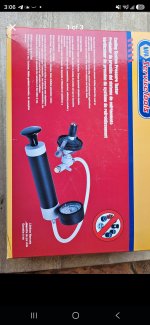
Is it something like this?
 

Attachments

  • Screenshot_20260622_150637_Facebook.jpg
    Screenshot_20260622_150637_Facebook.jpg
    1.8 MB · Views: 0

Lou C

Supreme Mariner
Joined
Nov 10, 2002
Messages
14,105
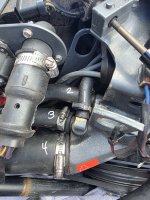
You basically have to disconnect the hoses for the exhaust manifolds at the manifolds and use a 3/4" adapter to connect those hoses together with the other ends still connected to the thermostat housing. Then disconnect the raw water inlet hose at the 'stat housing and make up an adapter that will allow you to pressurize the cooling passages.
 

cameron92

Seaman Apprentice
Joined
Jun 18, 2026
Messages
31
You basically have to disconnect the hoses for the exhaust manifolds at the manifolds and use a 3/4" adapter to connect those hoses together with the other ends still connected to the thermostat housing. Then disconnect the raw water inlet hose at the 'stat housing and make up an adapter that will allow you to pressurize the cooling passages.
Do I need to put the manifolds back on?
 

cameron92

Seaman Apprentice
Joined
Jun 18, 2026
Messages
31
Sorry for all the questions. I'm going to pick up a cooling system tester now. Once I get it hooked up, am I listening for where the leak is coming from?
 

cameron92

Seaman Apprentice
Joined
Jun 18, 2026
Messages
31
Sorry for all the questions. I'm going to pick up a cooling system tester now. Once I get it hooked up, am I listening for where the leak is coming from? And how much psi should I be putting in?
 

Bondo

Moderator
Staff member
Joined
Apr 17, 2002
Messages
71,457
Starboard Front to Back
110
109
115
120
Port Front to Back
110
85
105
105
Ayuh,...... With numbers like that, you have a rebuildable core, not a viable runner,........
A new/ rebuilt motor will be 'bout 150 psi across the board,....
 

Lou C

Supreme Mariner
Joined
Nov 10, 2002
Messages
14,105
Sorry for all the questions. I'm going to pick up a cooling system tester now. Once I get it hooked up, am I listening for where the leak is coming from? And how much psi should I be putting in?
The exhaust ports of the cylinder heads, and also remove the oil fill cap, and listen there.
after doing the pressure test (12-15 psi) if it fails, I'd probably also try to hook up a smoke machine, like you use for checking out exhaust leaks and evap system leaks, it can make the leak a lot more obvious. I used one to fix 2 evap system leaks on my old Jeeps and also for an O2 sensor code, that is affected by exhaust leaks.
 

cameron92

Seaman Apprentice
Joined
Jun 18, 2026
Messages
31
The exhaust ports of the cylinder heads, and also remove the oil fill cap, and listen there.
after doing the pressure test (12-15 psi) if it fails, I'd probably also try to hook up a smoke machine, like you use for checking out exhaust leaks and evap system leaks, it can make the leak a lot more obvious. I used one to fix 2 evap system leaks on my old Jeeps and also for an O2 sensor code, that is affected by exhaust leaks.
Thanks for all the help!

Just got it will report back with results.

What's the best case scenario?
 

cameron92

Seaman Apprentice
Joined
Jun 18, 2026
Messages
31
Ayuh,...... With numbers like that, you have a rebuildable core, not a viable runner,........
A new/ rebuilt motor will be 'bout 150 psi across the board,....
It actually ran and idles very well until about 3000rpm then it would die out after about 5 mins
 

cameron92

Seaman Apprentice
Joined
Jun 18, 2026
Messages
31
I've never been this deep into a motor. But I don't want to be completely out of 5 grand so I'm willing to try. Seller actually sent me back 1,000 because he felt bad.
 

cameron92

Seaman Apprentice
Joined
Jun 18, 2026
Messages
31
You basically have to disconnect the hoses for the exhaust manifolds at the manifolds and use a 3/4" adapter to connect those hoses together with the other ends still connected to the thermostat housing. Then disconnect the raw water inlet hose at the 'stat housing and make up an adapter that will allow you to pressurize the cooling passages.
And I would be pressurizing into the thermostat housing correct?
 

Lou C

Supreme Mariner
Joined
Nov 10, 2002
Messages
14,105
Nope # 4 is the circulating pump hose, #3 is the raw water intake hose, # 2 is the hose to the exhaust manifold.
 

tpenfield

Moderator
Staff member
Joined
Jul 18, 2011
Messages
19,195
This situation is playing out as many do . . . expensive lesson, that you will learn from
 

cameron92

Seaman Apprentice
Joined
Jun 18, 2026
Messages
31
I'm not sure if I have it hooked up right but it sounds like it's coming out from under the intake manifold. I hooked my tester into the hose off of the water filter I'm assuming it is. Pump air and I can hear it around under the manifold or maybe by the bell housing. Hard to tell.
 
Top