



I/O (Sterndrive) Conversion to Outboards

tpenfield

Moderator
Staff member
Joined
Jul 18, 2011
Messages
19,064
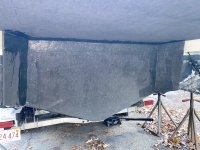
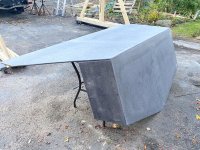
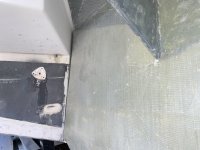
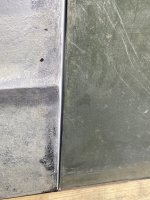
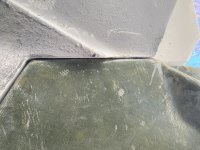
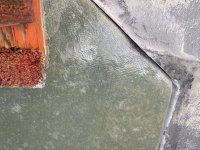
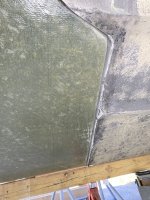
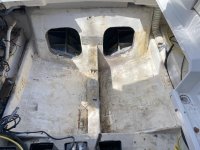
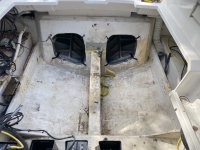
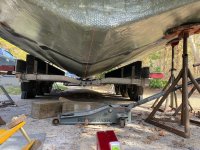
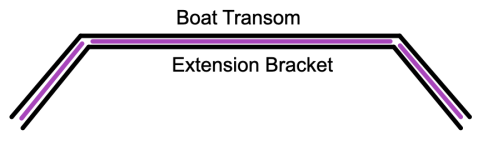
When I made the transom mating surfaces, I used corrugated cardboard as a 'padding' to mimic the thickness of fiberglass.
Transom-1.png
.
IMG_8799d.JPG
.
IMG_8800d.JPG
.
Of course, if the fiberglass is thicker than the cardboard I used, it would explain the fit problem.

The fiberglass was 2 layers, so about 0.09" each side . . . Probably more than I had allowed for.

The angle is 120˚ and the gap is 5/8" as mentioned. I can probably figure out the needed dimension reduction in order to fit.
 

tpenfield

Moderator
Staff member
Joined
Jul 18, 2011
Messages
19,064
Something isn't right . . . My geometry calc's are indicating that the extension bracket would have to be off by about 3/4" on the width to be stopping 5/8" short of the boat's transom. (possible, not plausible . . . :unsure: )

I have a hunch that it may be a matter of height, not width. So, I'm going to try lowering the 4x4 that I have running along the keel to see if that makes a difference.
 

Scott Danforth

Grumpy Vintage Moderator still playing with boats
Staff member
Joined
Jul 23, 2011
Messages
52,273
smear a bit of blue or yellow snap-line chalk on the boat hull surfaces.

then look for transfer to the extension
 

tpenfield

Moderator
Staff member
Joined
Jul 18, 2011
Messages
19,064
Looking ahead . . . the test fit is also serving as a rehersal of the actual installation process.

My plan is to . . .
  • Position the extension bracket near the boat/transom
  • Apply prodigious amounts of permanent adhesive to the contact areas
  • Pull & lift the extension bracket tight to the boat (ratchet straps, clamps, etc)
  • Let the adhesive cure for a while (days)
  • Drill the bolt holes
  • Install the bolts
  • Scarf joint the perimeter areas
Then fairing, gelcoat, . . . barrier coat, anti-fouling paint as needed.

Comments on the process? :unsure:

Also, there has been some discussion about 3M 5200 adhesive as not being what it used to be . . . Boatlife adhesive being a preferred alternative. @Scott Danforth , @Pmt133 . . . perhaps a few others.

Can you expand on that . . . issues, etc.? :unsure:
 

Scott Danforth

Grumpy Vintage Moderator still playing with boats
Staff member
Joined
Jul 23, 2011
Messages
52,273
Ted, I would assemble the two parts with PB between the two.

You are not going to remove the extension, so make it permanent

Boat caulk and 5200 are sealants, not structural adhesive
 

Pmt133

Lieutenant
Joined
Jan 6, 2022
Messages
1,497
Scott seemed to have the worse of the issues than I did. But I'll tell you what I got.

On the 330 we ran a bead of 5200 around the exhaust port to reseal the flange and did the old wipe to finish the bead like caulking. That was 15 years ago and it is still there. You can't scrape that crap off if you'd try. During my rebuild I was using it on a few screws I was bedding for the deck. They were getting glassed over anyway so it didn't matter. About 2 weeks later I cleaned those up and I could scrape them with my fingernail and get them off. I've removed 5200 a lot in my life and it was always hell on everything. Even a smear on a screwdriver bonded like nothing I've seen before and this stuff came off like tape...

On my swim platform mounts it shrank severely and is cracking at only 2 years old. Granted that gets some sun. But so does that 15 year old job on the 330. I bedded the bolts and motor mounts on the 4.3 with it when I originally installed it in 23 and I've had to use hoists to seperate them in the past... they just lifted off and the bolts backed right out. Something changed and it ain't the same product I used 15 years ago or that dad used in the 80s. It even cures too fast now. That stuff used to take weeks to set and it's good to go in a few days now.

I did try the PL marine, and that behaves more like how I remember 5200 fast cure working. That being said for underwater fittings, dad almost always used boat life on customers boats. Not for those reasons but for if he ever had to get it apart again it would come apart.

That's all I got. Scott has the rest.
 

tpenfield

Moderator
Staff member
Joined
Jul 18, 2011
Messages
19,064
Ted, I would assemble the two parts with PB between the two.

You are not going to remove the extension, so make it permanent

Boat caulk and 5200 are sealants, not structural adhesive
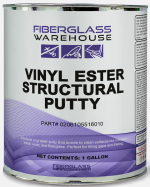
I am leaning this way . . . I think the stuff is often called structural putty or deck putty. Basically, PB with a fiber content IIRC.

I think I can get VE structural putty . . .
.
VE-putty.png
.
Or perhaps make my own. I can get VE resin for $49/gallon and I have lots of fiberglass material to chop up.
 

tpenfield

Moderator
Staff member
Joined
Jul 18, 2011
Messages
19,064
I can also get a 5 gallon pail of 'hull & deck putty' for $315 . . . I'll have to verify if it is VE or Poly. (prefer VE)
 

alldodge

Moderator
Staff member
Joined
Mar 8, 2009
Messages
43,883
Forget the exact name of the product but something like Bondarite and used to adhere transom wood to hull
 

tpenfield

Moderator
Staff member
Joined
Jul 18, 2011
Messages
19,064
Checking the measurements on the transom face vs. the extension bracket. . .

The width of the top is fine (actually 1/2" to spare)
The lower portion looks to have flared out a wee bit . . . probably during the framing of the outside stringers. I did some grinding (not a lot) and will see how well it fits.
 

tpenfield

Moderator
Staff member
Joined
Jul 18, 2011
Messages
19,064
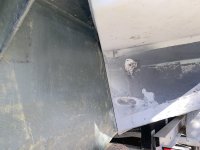
The extension bracket is fitting better. I think a 1/2" spacer will do the trick.
.
Here is the starboard side
.
IMG_9426.JPG
.
The port side seems to be the issue, as it flairs out about 1/4" at the bottom. The spacer and maybe a little bit more grinding here and there should do the trick.
IMG_9427.JPG
Using deck putty makes more sense, given the gaps that will need to be filled.

Overall, the outboard transom is square within 0.1" . I'll be adding a spacer to the face of the extension bracket.
 
Top